


Slowly reading Greek literature, tragedies, and mythology as a long, lived thing by staying inside the events until they start giving me meaning.
Paris must choose between three goddesses. Each offer is a promise about what Paris gets to have and who Paris gets to be. Paris chooses what he wants most, and a private desire turns into a public war. Hera and Athena offer him futures that require a new self. Aphrodite wins because her offer doesn't require Paris to become someone new. This essay is about the difference between becoming and admitting. About offers that change you versus offers that reveal you.
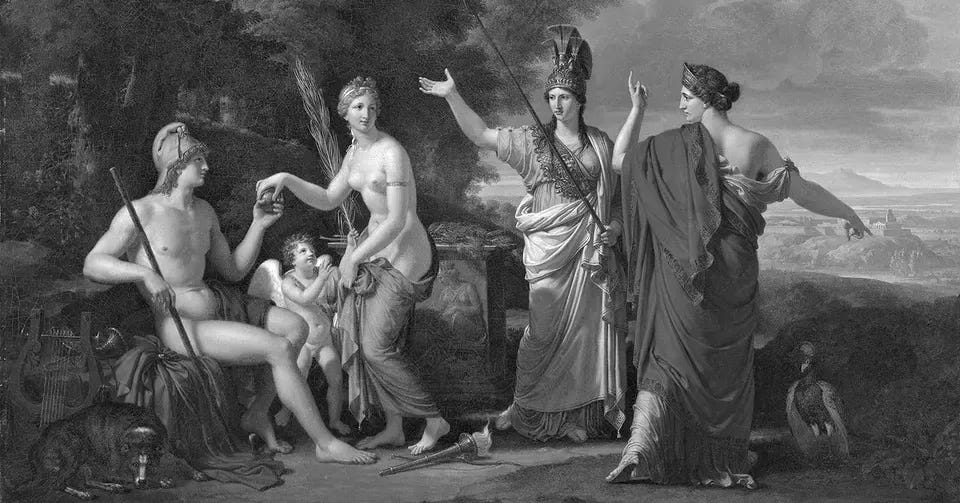
Desire.
That’s what comes to mind as a quick answer when I try to answer the question: Why did Paris choose Aphrodite? The most beautiful woman in the world as his wife. After reading the judgment of Paris, I slept with one question still lingering in my mind: what would I do if I were Paris and was given three bribes, one of them being “the most handsome man in the world as a husband”? Would I choose Aphrodite? Why and why not? That’s the thought that kept me up one night, and I was going round and round revolving around the three bribes/gifts the goddesses had to offer, and choosing one (for a second forgetting the whole point of this petty battle being about “who’s the fairest?”). There’s something more than just desire to drive Paris toward picking Aphrodite, and after a rabbit hole of thought, I ended up with: Hera and Athena offer him futures that require a new self. Aphrodite wins because her offer doesn’t require Paris to become someone new.
If I imagine being in Paris's shoes and try to take a look at these three goddesses and see them as women, perhaps they are not "women" so much as three forces/powers wearing faces and bodies. That is the first thing I want to hold onto and forget for a second about the goddesses, which will let me not see this as a beauty contest, because in the end it was not. So, it is power speaking in three accents, more precisely, institution (Hera), performance (Athena), want (Aphrodite), standing in front of a human being (I'm stressing it again, a human) whose hands are made for ordinary, mundane, mortal things. The story I was taught in school makes a big deal out of the apple, gold, beauty, the writing, but when I read it again after so many years, all I keep seeing is the hand. A poor mortal hand taking a problem that is too heavy for it, not in the way gold should be, but the weight of consequences, or the weight of public meaning, or the weight of being turned into a symbol (or even a fool) before you even know you are in an epic story.
Then comes Hera, whose offer is almost too large to be heard by the person she is addressing. Choose me, and I will make you king, not of a small place, but where power holds and lasts. What this one force is offering: position, or in other words institution. If I'm being this hand, and I chose this force, then it is offering me a self with a future with a throne, and a life that must stretch to contain it. But then the small mortal hand is used to tending goats and sheep, that can't even imagine where a life with a throne would go, without the inner furniture for it yet. This really seems like handing a child a crown and calling it practical. When one picks this offer, it demands you become someone else first, and then perhaps you can have it, and the becoming itself will justify the wanting: you will be king, so you may want what kings want.
Athena's offer comes with a different seduction: if you want kingship, I can give you something more reliable than a throne — a skill, victory, a mind that does not lose. This force is offering consequences, competence, strategy, excellence, admiration that is earned. Because a throne can make you admired for what you have, this will make you admired for what you can do. Now going back to the image of mortal hands of a shepherd, this offer sounds like a weapon which he does not know how to hold.
Then Aphrodite: You don't want a throne, you don't want a battlefield, you want one thing, and I can see it in your eyes. Companionship, passion, desire, and love for a lonely life is all that it wants. This force is not promising a future self, but choosing it will give you what can make your present self more beautiful and fulfilling. And that there is where the myth turns for me from a simple "bribe" story into something more psychological. Because so much of what we call "choice" is really a choice between the selves we are willing to become. It beautifully fits inside the life he already has sliding into the groove that already exists in him. He can stay him. All the goddesses offer him what a human is allowed to want and also offer him what a human is allowed to be. Hera and Athena offer futures that require a new self, where Aphrodite's offer doesn't need any transformation or ask for practice or ask him to earn; just asks to admit the want, a door that's already warm from his own hand.
There is a temptation to moralize this, to say that Paris chooses the easy path, or that Aphrodite is a trickster. But human desire alone can make kingdoms rise and fall. Put that aside for a moment. "You can stay you" — no transformation required at first, no need to imagine a new identity, no need to stretch and fail publicly, no need to tolerate the long pain of becoming eligible for what you want. Hera and Athena say, in their own ways, you can have it later, but first homework. Aphrodite says, you can have it, and you do not have to become someone else to deserve it.
The more I look at it, the more I see that the myth is not only about which bribe is stronger, but about which kind of wanting is bearable. Given that tense situation of three divine forces in front of him, it is very easy to choose satisfaction and comfort. It frames the choice as a risk calculation that happens inside a trembling body. The word "fairest" is really a trap-word, which locks a whole future into place. When Paris chooses Aphrodite, I imagine her being unceremonious, that apple was never the prize to her. She had to win the contest that claims the winner to be the most beautiful. What remains of a goddess of desire when she is publicly told she is not the most desirable?
After all the fuss is over, then the actual problem begins for the mortal hands, because Paris might think the danger is in what he chose, but the real danger is that the world now has a public record of who humiliated whom, and that is him. What Hera and Athena heard from his mouth is not "Aphrodite"; they heard, "You lose," and a story that will be retold. He becomes the mouth that spoke the humiliation, and mouths can be shut. To learn what is the cost to embarrass a queen and the goddess of war. Threats aside, I believe he chose honestly; he chose what he wants the most. Is it honest to choose the offer that asks the least of you, because it matches the self you already are? I do not know. I only know that myths care about consequences.
It makes me think of how rarely our choices remain private even when they begin in private desire. A private desire turning into a public war. Sometimes "love" is the word that makes theft sound socially acceptable. Theft. Love. The names we give to the same act depending on whose side we are on. I'm not sure what I think about Helen as a prize promised in exchange for a verdict, and a desire becoming an excuse for a war where so many bodies will be buried. Keeping aside Helen for a moment, what's interesting is Aphrodite wins because she offers something that requires no becoming, but something inside him, and she dressed it as destiny.


That night, I kept thinking about the difference between becoming and admitting. Becoming has a kind of dignity to it in modern culture and looks like effort and growth and earning. But there's its own cruelty: it demands that you inhabit a self before it is fully real, and it makes you perform eligibility. Admitting, on the other hand, can look like laziness, like indulgence, like weakness. It can also be the most honest thing you do, because it strips away the narrative of improvement and leaves you with the raw shape of want.
I'm not saying comfort zone is evil, but the offer that lets you stay you can also trap you inside the smallest version of yourself, keeping you from ever finding out what you could become. "Becoming" is the first step towards change, and also asks you to act as if you are already the person you are trying to become. And this is where the ethical question starts to wobble for me. Yes, becoming can be truthful, but it can also be a tactic, a way to manipulate yourself. A way to pretend you're somebody else and keep an identity project going even when the interior reality is different.
The opportunities that tell you you don’t have to change are more dangerous than the ones that ask you to change. And when you flip the coin to: becoming in private vs. becoming in public, then what’s your admission or accountability level?
We are living in a moment where these admissions are becoming social media content, where people confess their transformations as a form of proof. I see seductive "becoming her/him" essays, videos, everywhere. I'm becoming. This year is about becoming. The morning routine. The night routines. The glow-ups. The reset. The new era of someone who is always on top of the day. It's so exhausting because becoming feels like there is a future self already real and you are just catching up. Once you say "this is who I am becoming" in public you can't easily revise it without looking like a fool. People will read it as a failure or even lying. So the public transformation becomes its own trap. You are forced to keep being someone you may or may not "really" be, because the performance has witnesses now. This is where the apple returns to me. It forced a public verdict of what you chose to be.
I love "becoming," and I have many versions of myself whom I want to become. But my biggest problem with running after becoming is that when I keep "becoming," I keep postponing the moment of actually "being." I stay in preparation forever and can never admit what I really want without the armor of self-improvement. As if sometimes I forget what I am if I am not becoming her.
Alright, let's go back to our myth. I'm not saying Aphrodite is "evil" and Athena or Hera are "good." The three goddesses are three different ways of laundering desire and greatness into a life.
My Paris answer
If I were Paris, I'd choose Athena. A competent mind, where the wanting is justified by ability. Not "I should have it because I'm queen" but "I should have it because I can win." I admit that sounds brave in theory, but in practice it is terrifying. I can clearly see a downfall to this offer because a mind that doesn't lose implies a life where losing is intolerable. That sucks! Because life will make you lose sometimes.
What’s yours?
Next up
I'm reading the chunk of texts and references where Paris escapes with Helen and how old oaths force the Greek leaders to join the war.
I'll share more of my thinking-on-paper thoughts as they come to me. Until then, take care.
Yours in thought,
Yana
Reading list
Image credits
Source unknown, copy from Panegyria
Judgement of Paris by Peter Paul Rubens
Paris in the Phrygian cap by Antoni Brodowski
Judgement of Paris, fresco from Pompeii