At What Age Do We Understand Death?
We Are Seven, by William Wordsworth

Dear Reader,
At what age do we understand death? I found myself asking this after reading William Wordsworth’s We Are Seven. I have just read it and could not help but write to you about this beautiful poem.
In the poem, a man argues with a little girl about her family. And she insists there are seven siblings, though two are dead and they lie in the churchyard. This poem is not just a dialogue between a child and an adult, but between two worldviews.
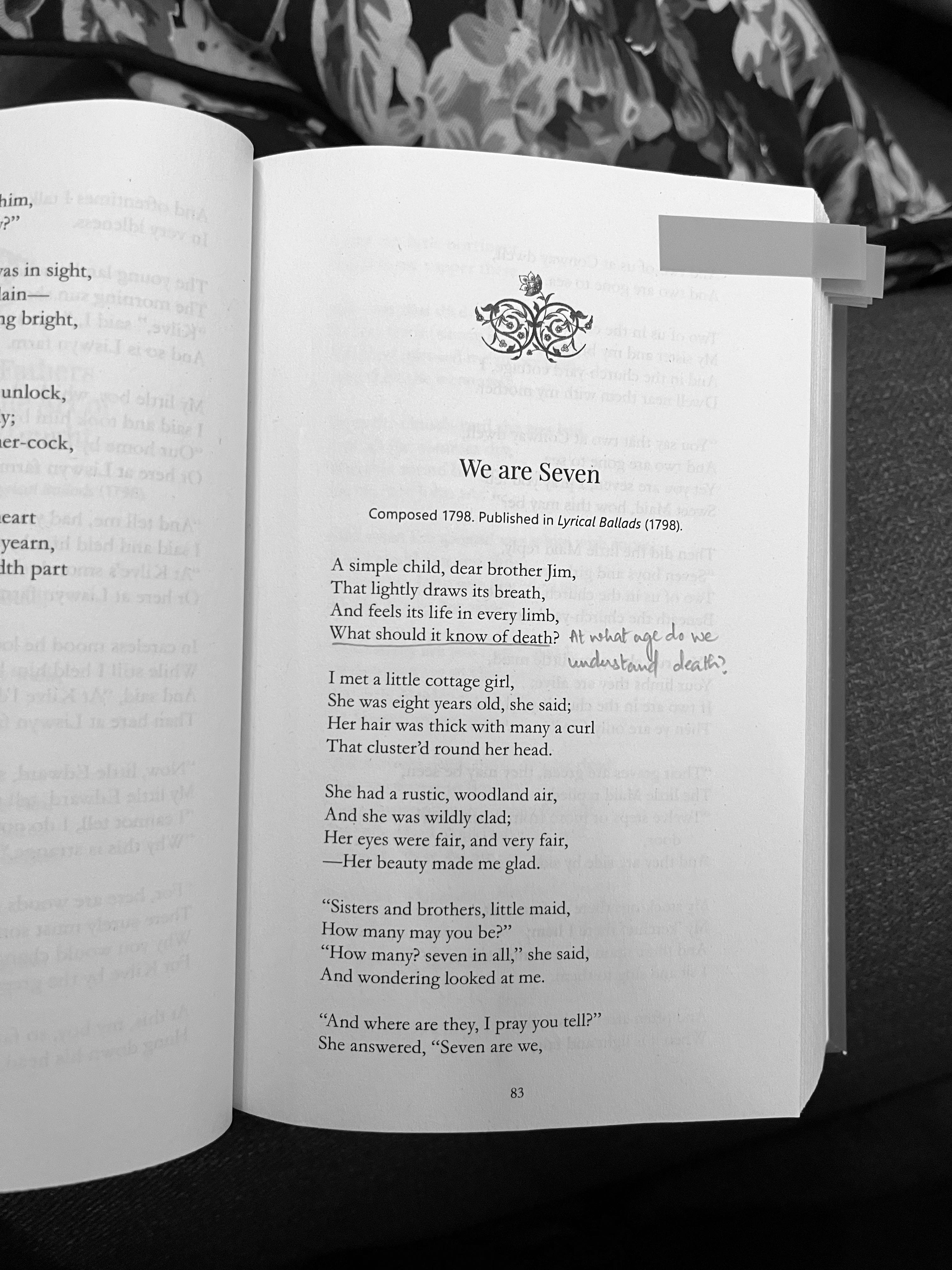
“A simple child, dear brother Jim,
That lightly draws its breath,
And feels its life in every limb,
What should it know of death?”
When I started reading the poem, these lines made me question: “At what age do we understand death?”
From the adult’s perspective
“You run about, my little maid,
Your limbs they are alive;
If two are in the church-yard laid,
Then ye are only five.”
For the adult character in the poem, death is subtraction. I think for simplicity and certainty, we flatten death as a finality.
From the child’s perspective
“But they are dead; those two are dead!
Their spirits are in heaven!”
’Twas throwing words away; for still
The little Maid would have her will,
And said, “Nay, we are seven!”
But to her, their physical absence has not negated their presence, or erased their relationships, but just changed the form. She says she sings, she sews, she eats by their graves. And they sit with her when she eats, and she talks with them.
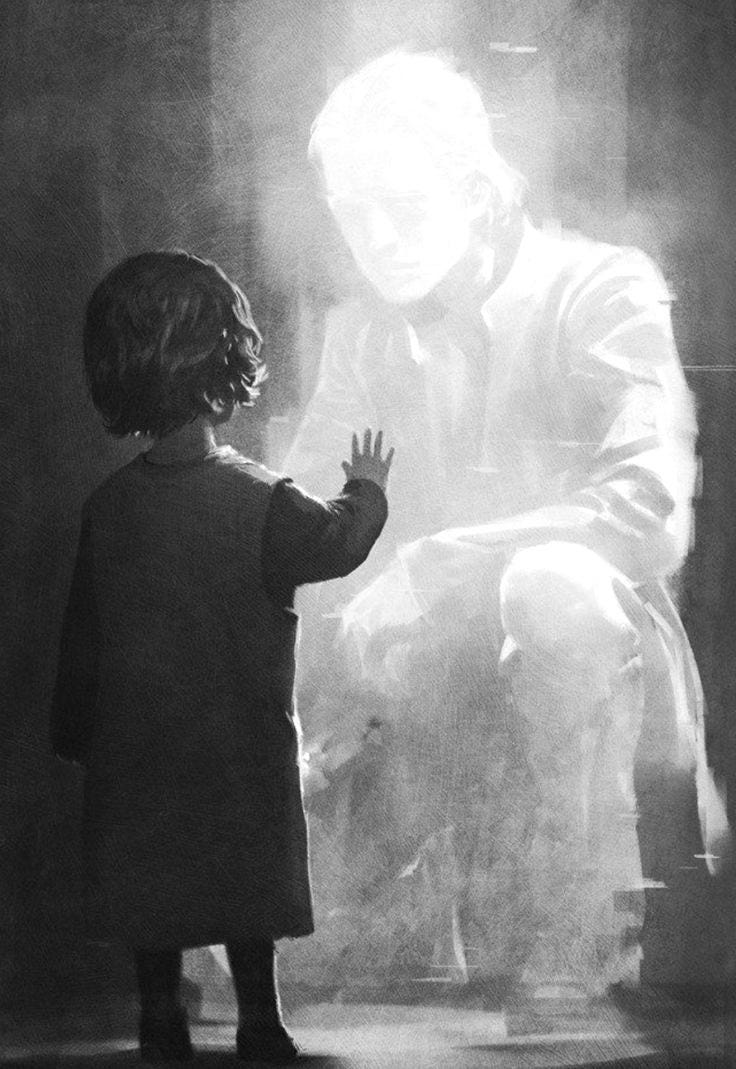
The child somehow “knows” her siblings as part of her lived world, though she cannot see them.
After reading the poem, I think children already understand death, but differently. It is not that children do not know death, but adults have forgotten or unlearned how to know it as a whole.
So, I think the question I need to ponder is: “At what age do we stop understanding death in the way she does?”
That shift from our intuition to conceptual knowledge → when does this happen? And also, which perspective is truer?
When I googled for a bit, here is what studies say. Interestingly, research mirrors Wordsworth’s intuition.
Note: If you are interested, I have added the links at the bottom of this piece.
Research says:
Ages 3-5: Children often see death as reversible or temporary, like sleep.
Ages 5-7: They gradually understand irreversibility (death cannot be undone) and universality (everyone dies).
By 7-10: Death is understood biologically, but it also adds existential anxiety.
So, biologically, it is around seven. We learn death as a fact around seven. However, like the famous saying goes → Knowledge is not the same as understanding.
But existentially, I think we never will. Because it seems like we keep learning and unlearning death at every age.
Perhaps I should not be asking “when” but “how”.
Yours in thought,
Yana
Research Links Here:
https://www.nationalgeographic.com/science/article/when-do-kids-understand-death
https://www.childbereavementuk.org/childrens-understanding-of-death-at-different-ages
Discussion about this post