

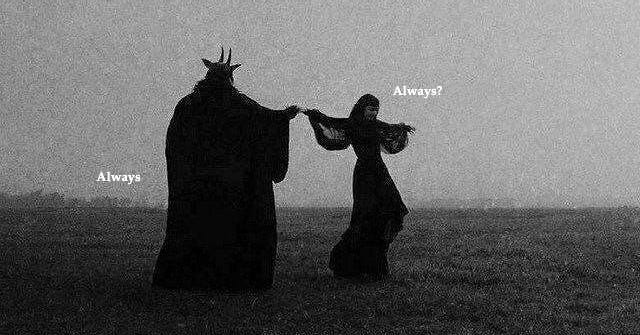
Standing outside the gate
I picked up Robert and Jean Hollander’s translation of Dante’s Inferno1 today and made it only as far as the introduction before my mind began filling with questions. I have yet to enter the dark wood. I have not yet passed through the gate of Hell, crossed the Acheron, or met any of the souls whose punishments have survived in the cultural imagination for seven centuries. At this very moment, I am standing just outside the poem, gathering impressions of its shape, its theology, and the strange people and figures waiting within it.
Everything I write in this essay here carries the eagerness and naïveté of someone at the beginning. I feel a little like a puppy encountering grass for the first time, overwhelming by the discovery that there is so much here to smell, touch, and misunderstand. Mind me, Dante has not yet had the opportunity to correct me.
I would like to think that, this, is the right condition in which to begin reading him. The Divine Comedy is in fact itself concerned with a person who begins in confusion. Robert Hollander describes the pilgrim’s journey as a model for the reader’s own movement through the poem: we are expected to learn as Dante learns, and perhaps to discover that our initial sympathies and judgments cannot always be trusted.
For now, I know only the outline. A living Christian travels through the kingdom of the dead. His first guide is a Roman poet who lived before Christianity. The damned speak, remember, argue, accuse, suffer, and somehow continue defending the desires and decisions that brought them there. Beyond Hell there is a mountain called Purgatory, and beyond that mountain there is Heaven. And the complete journey moves toward salvation and the vision of God.
Why does hell dominate the imagination?
Yet even before beginning the journey, I have heard far more about Dante’s punishments than his salvation. I have seen diagrams of his circles of Hell. I know that the lustful are blown about by winds, the traitors are frozen in ice, and that terrible bodies experiences punishments shaped by the sins that governed them in their lives. I have encountered the adjective “Dantean” applied to disasters, violence, and scenes of violent confusion. I have rarely heard it used for the vision of divine love with which the Comedy ends.
Why does Hell so completely dominate my imagination that Dante can be mistaken for a poet who wrote only about damnation?
I might understand that better once I have read the poem. At the threshold, however, I find myself beginning with many questions.
Why Virgil?
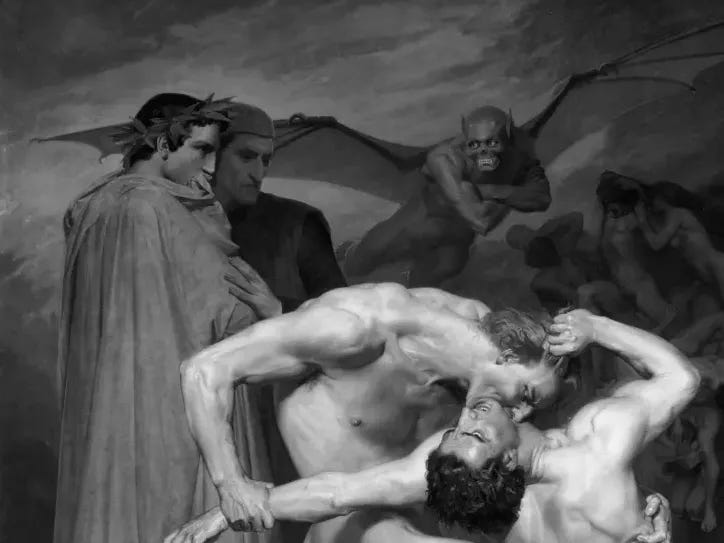
I understand part of the literary answer. Virgil’s Aeneid2 helped make Dante the poet he became. Similar in Aeneid, Aeneas enters the underworld and encounters the dead. Dante’s journey therefore follows a road that Virgil had already opened in poetry. Hollander’s say, Virgil could lead Dante into darkness because, in a literary sense, he had entered it before.
I think the relationship goes much deeper than that borrowed episode. Hollander describe Dante’s engagement with Virgil as one of the most complex examples in literature of a later writer taking up the work of a precursor. The Aeneid helps Dante structure and populate the otherworld, while Virgil’s language continues to echo through the Comedy even after the Roman poet is long gone and has disappeared as a character. Dante’s attachment to Virgil appears to have shaped the very decision to write an epic poem about serious matters3. Martin Eisner similarly notes that Dante uses Virgil throughout the Comedy to organize the landscape of the afterlife and to guide his encounters with other poets5.
Virgil offered him a form of a journey, the inheritance of a poetic tradition, and an example of how history, empire, exile, suffering, and destiny could be gathered into a single epic. Virgil gave Dante something a poet could follow, according to Hollander. Virgil is a classic allegorical interpretation of human reasoning, the faculty capable of guiding a person through the recognition of sin but incapable of bringing the soul into the direct presence of God. Hollander complicates that interpretation. Dante’s Virgil cannot be reduced to a psychological faculty. He remains recognizably Virgil: a Roman, a pagan, the author of the Aeneid, and the poet Dante considers his master. His importance comes partly from what he represents, though it also comes from who he was and what he wrote.
A guide who cannot join the destination
This makes his presence feel more tragic to me.
Virgil can guide Dante through Hell and up the mountain of Purgatory, but he cannot accompany him into Heaven. He can help another person understand the moral structure of a Christian universe without sharing in the salvation that gives that structure its final meaning. It eerily sounds familiar to the meaning of a “teacher”, so simply to understand, how a parent teaches the child on life, but they cannot live the life of the child.
A pagan poet guides a Christian pilgrim toward a God he cannot see. That is tragic to me.
There is something painful in being able to lead another person toward a place one cannot enter oneself. Dante could become Dante because of Virgil, while Virgil could never become what Dante’s universe required him to be. The guide makes the journey possible and remains excluded from its destination. Dante loves Virgil. Hollander writes that Dante “could not do without him,” even as the Comedy repeatedly reveals the limits of Virgil’s knowledge and authority. Virgil can be revered, corrected, surpassed, and mourned at the same time.
Who is your Virgil?
This makes me wonder about the guides in our own lives. Who is my Virgil?
I do not know. Perhaps we rarely recognize the people or books shaping us while the shaping is taking place. We experience attraction, irritation, imitation, and the recurring desire to return to a particular voice. I would like to imagine, Virgil was that voice for Dante. Years later, we may understand that someone taught us how to see. By that time, we might also have travelled beyond the limits of what they could teach us.
I want to believe a Virgil is someone who leads us far enough that we eventually have to continue without them. And that limitation do not erase what they gave us. Sometimes they might even become part of the gift because they force us to discover where we must part from them.
So I want to ask you: do you know who your Virgil is? Who gave you language for something you could feel but you do not have a name for it? Who helped make you yourself?
Why does Dante give the damned so much room to speak?
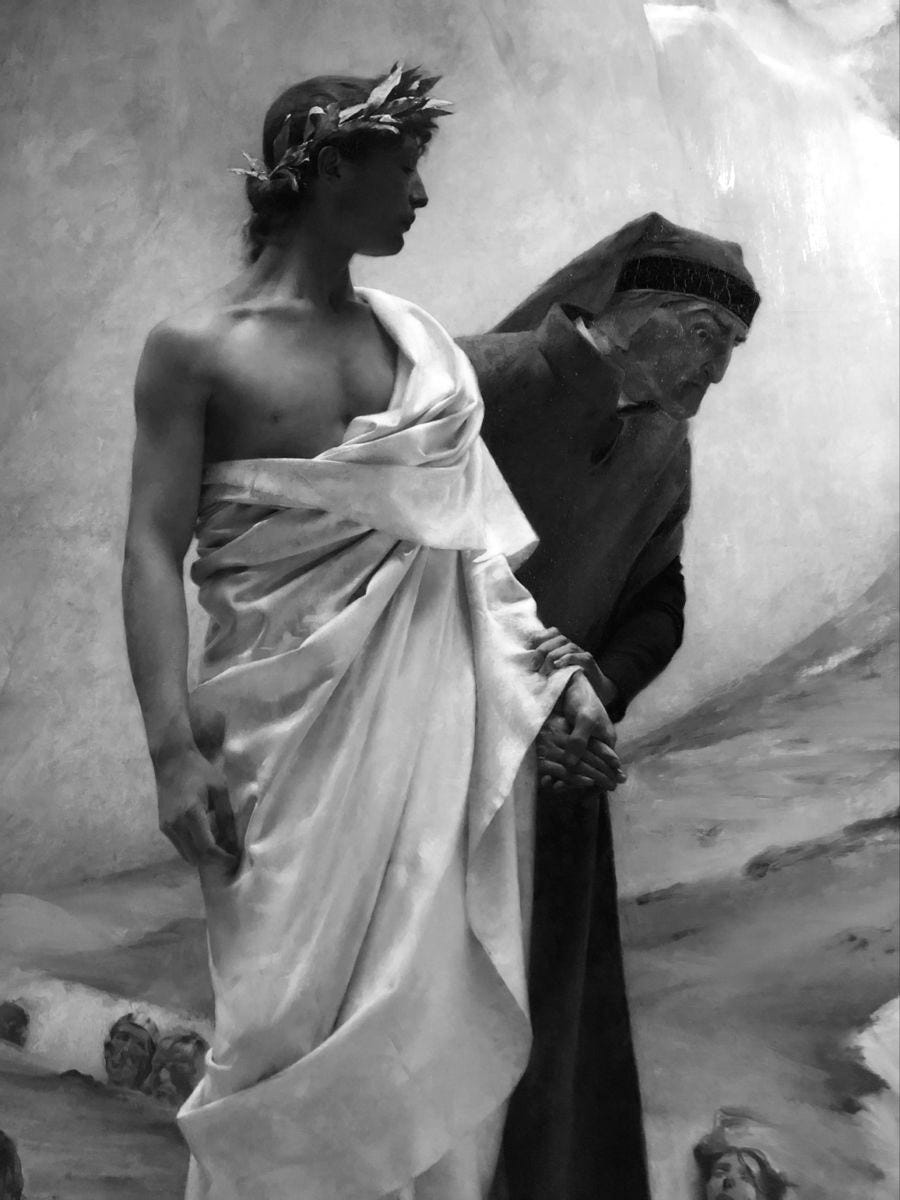
The obvious answer is that Hell is a place of moral instruction. Its punishments reveal the nature of the sins being punished. I learnt that Dante’s system is often discussed through the principle of contrapasso, in which punishment corresponds to sin through resemblance, reversal, analogy, or consequence. Hell, turning inward inclination into outward conditions.
The souls in Dante’s Inferno, speak. They tell stories about themselves. They remember political grievances, betrayals, loves, families, ambitions, and deaths. They can also be seen defending their motives and redirect blame, while some remain attached to the identities they possessed while alive. Even in eternity, they are concerned with how they will be remembered on Earth.
Hollander argues that the reader must learn to distinguish between the authority of the poem’s theological structure and the emotional force of the sinners own accounts. Several of the damned are sympathetic because Dante gives them dignity and intelligence, making their pain recognizable. They often present themselves as the victims of love, fortune, politics, or other people, moving the reader4.
I am yet to dwell deeper with these souls, but I am already intrigued by the risk Dante takes in allowing them to speak so well. A moral allegory could have made every sinner repulsive and every judgement immediately visible. But here, the damned tell beautiful stories about the desires that destroyed them.
Damnation contains narrators.
I would like to imagine that is the reason why Hell has remained so culturally alive. The souls have histories, explanations, wounds, and unfinished arguments. They may have been judged by God, but they have not necessarily surrendered their own interpretations of themselves.
That makes me want to say, that saints might have reached an answer. The damned remain imprisoned within their questions, and perhaps this is part of their Hell.
Memory but no possibility of change
They cannot stop explaining. They cannot imagine themselves outside the stories they have already chosen. Their punishments continue eternally because the self that created the sin has become fixed. they possess memory without the possibility of change. They almost seem like they can look backward, but they cannot become otherwise. That may be more frightening than any physical torment. To be damned would mean becoming inseparable from one interpretation of oneself. Every explanation would lead back to the same desire. An eternal loop of personalized Hell. Every explanation would lead back to the same desire. Every memory would confirm the same problem, and they do not realize the possibility of change.
I want to know whether Dante’s sinners recognize themselves in their punishment or remain trapped within their own explanations. Do they understand where they are, or do they know that they are suffering? Can a person acknowledge the consequences of a choice while remaining incapable of seeing the choice itself clearly?
I suspect that I will be tempted to pity them. Dante may ask me to examine that pity. Am I responding to suffering itself, or have I been persuaded by a compelling narrator? Does sympathy help me see another person clearly, or can it become a way of me avoiding judgement? I am very enthused to see if I can recognize pain without accepting the explanation the sufferer gives for it.
While I write these questions, they are already making me feel that my upcoming study sessions will feel morally unstable. I am preparing to enter Hell as a spectator. I know that the figures I encounter have been condemned by the universe of the poem, but I do not yet know whether I will agree with its judgements. The poem may reveal something about my own instinct through the people I excuse, the people I condemn, and the punishments I find disproportionate. And that, my darling, is scary.
Giving darkness an architecture
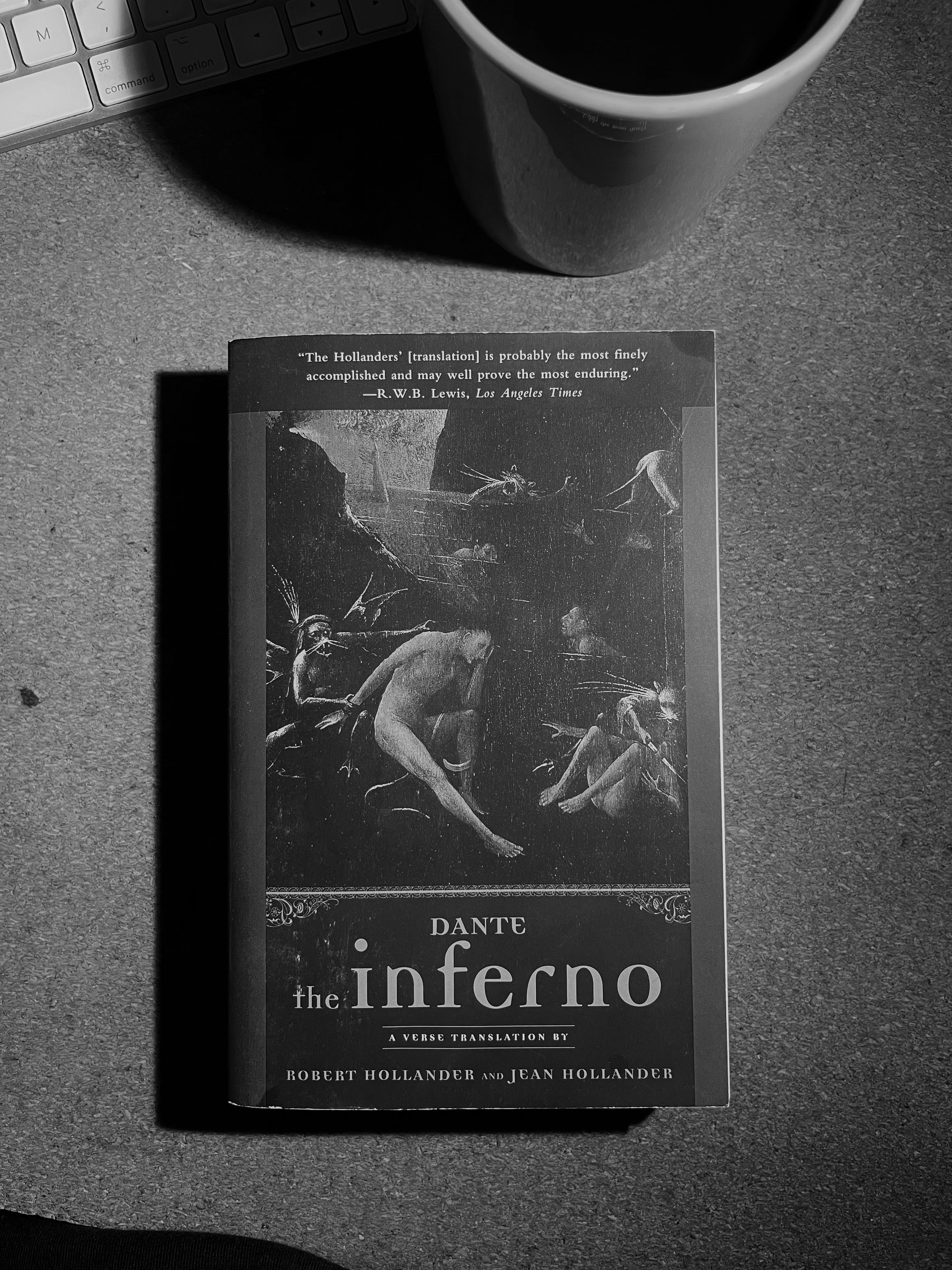
Fear usually tells us to look away from Hell. Dante constructs a poem that requires us to enter it, move through it, listen to the people who live there, converse with them. His Hell has circles, ledges, gates, rivers, weather, laws, histories, and conversations. It contains an entire geography of moral failure. I find this strangely stimulating.
In much of the psychological advice I have encountered about fear, the first instruction is to name the thing that frightens us. A shapeless fear gives the mind nowhere to stand. Once fear acquires a name, boundary, or structure, it can be approached. It may still remain frightening, but now it has become available to thought.
Dante appears to do something similar by giving darkness an architecture. Hell is no longer an undefined region beneath existence. It becomes a world through which one can travel, with its chaos having an argument and it’s suffering has categories. Even the most frightening landscape ever known to humankind, now, has a path running through it, and the pilgrim has a guide who knows enough to take the next step. But will this architecture make the darkness more frightening or less?
Before learning how Dante understands salvation, I find myself drawn toward his understanding of ruin. I want to watch a desire become a destiny. I want to know how love, appetite, pride, violence, deceit, or resentment can grow so powerful that a person becomes unable to imagine themselves apart from it. I want to know whether Hell changes anyone, although change may be the one thing Hell no longer allows?
Why is suffering easier to imagine than blessedness?
This bring me back to the question with which I began. Why does the Inferno dominate my imagination more completely than Purgatorio or Paradiso? I can only think that suffering is easier to picture than blessedness.
Pain gives us events and that narration has a body. A person is chased, burned, frozen, torn apart, transformed, silences, or forced to repeat an action without end. Punishment here can be represented through images that can be felt and easily understood.
Perfect happiness is harden to imagine, I reckon. When I try to picture hope, it generally becomes very vague. I can imagine the removal of pain, but the absence of pain is not something I can quite contemplate as the image of blessedness. I can imagine a problem being solved, though I struggle to imagine what desire becomes when nothing remain missing, and everything is as is.
Hell preserves many of the conditions from which stories are made of: conflict, memory, personality, grievance, consequence, and frustrated desire. Heaven asks the imagination to approach fulfillment and vision of God. I understand why a person runs from pain more easily than I understand what it means for a soul to rest in perfect love. Hell peaks through the recognizably human language of wanted. Paradise, I think, might require another language altogether. I wish I find another arcane poet who journey’s me through Heaven.
I think this is why Dante’s punishments survived for so long, even among people who no longer believe in his theology. One does not need to accept the literal existence of Hell to recognize the experience of becoming trapped inside an appetite, a resentment, a torture, or a story about oneself. I would like to imagine, Dante gives that psychological condition an eternal landscape.
Heaven, I think asks a more difficult question: if I release everything that changes my changes, what would remain of me? That question leads me toward something even less stable.
Why do we invent gods?
I suspect we are searching for hope. We gather hope into a figure, give it a name, and call it God. We want to believe that darkness has an edge, that suffering belongs to some unknown shape, and that continuing through life amounts to something more than postponing death. God becomes the place where this hope can live.
At times I think darkness may be the ultimate truth and God only a phantom hope. Perhaps we create divine order to endure the darkness. We image that suffering means something because meaninglessness would leave us with nowhere to place our pain into. Does this even make sense?
Yet the moment I call hope a phantom, I have already assumed that darkness is more truthful. Should I even place this privilege into it? Perhaps I am too ready to regard hope as an invention while accepting hopelessness as a discovery.
Dante seems like someone against whom I can test this suspicion. He would presumably reject my phrasing from the beginning. Within his theology, human beings do not invent God to give darkness meaning. God is the reality by which both darkness and meaning become intelligible. I think he sees Hell as something that exists within divine order rather than beyond it. In that case, even damnation testifies to the structure of God, or creation.
Again, this does not erase suffering into happiness. Dante built an entire world around the claim that darkness has meaning, and some of that meaning takes the form of judgement that can never be reversible.
Before Dante corrects me
There is something terribly fascinating about discovering that an arcane person who lived a septcentenary ago thought something so strange that I suddenly need to understand why. I want to see, as far as another person can, what Dante saw. I want to understand how Hell, Purgatory, Heaven, pagan poetry, Christian revelation, political history, grief, judgement, and divine love could being in one imaginary universe, strikingly beautifully.
Reading has always given me a temporary access to a mind that could never have imagined me. I cannot ask Dante my questions, but I surely can enter the poem in which he spent years and years answering his own.
For now, I am standing outside the gate. I have questions about Virgil, the damned, the architecture of fear, and the gods. I suspect Dante will complicate all of them.
How strange. How beautiful. Tell me more.
Notes and further reading
Dante Alighieri, Inferno, translated by Robert and Jean Hollander.
Virgil, The Aeneid.
Robert Hollander, “Dante’s Virgil,” Princeton Dante Project.
Robert Hollander, “The Moral Situation of the Reader of Inferno,” Princeton Dante Project.
Martin Eisner, “Dante’s Guide: Virgil, Aeneid,” Duke university’s Dante’s Library.