

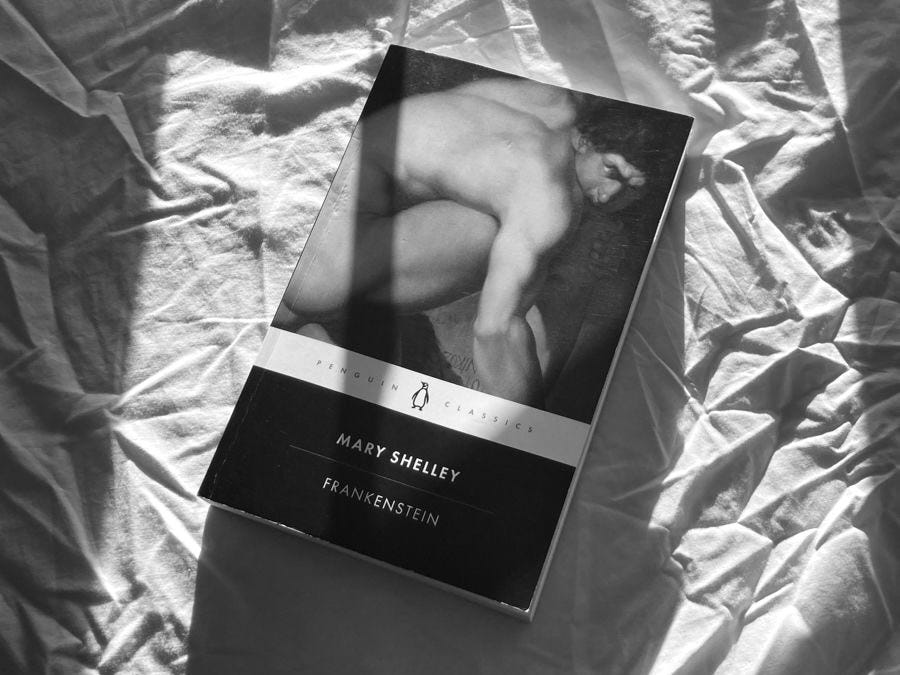
I’m writing this just after finishing the introduction and Captain Walton’s letters in Mary Shelley’s Frankenstein. It’s my first encounter with the novel, and everything I’m about to say comes from that incomplete vantage point, from early assumptions and intuitions of a story I haven’t yet seen in full.
Dear Reader,
When I opened Frankenstein, I expected Victor in his laboratory, hands shaking while operating on his creation. Instead, I found letters! (Captain Robert Walton’s letters to his sister Margaret). And you know that I love letters because they are intimate and they reveal character in ways direct narration cannot.
Every Catastrophe Has a Prelude
The more Walton wrote, the more I felt I was watching a man who is both ambitious and terribly lonely. And that combination makes me feel uneasy because it so often ends in self-inflicted tragedy. I can only fathom how letter writing in 19th-century literature wasn’t some narrative technique but a way to explore interiority, to reveal the private thoughts characters wouldn’t speak aloud. I think, in Walton’s letters, it is a deliberate effort to say that not just what happens, but the temperament that makes catastrophe inevitable.
All the ice Walton describes feels like the kind of cold a person could carry when they convince themselves that destiny requires isolation. The Arctic expedition he’s gone to; how extremely ambitious, frozen, and remote. But it is beautiful in its danger. When the rescued stranger (I assume it’s Victor) warns Walton of the dangers of ambition and the hunger to traverse a path “no man has ever” walked, I wondered if Walton is mirroring Victor without even knowing it.
Perhaps that’s why Mary chose this beginning. Not to show us the monsters first, but to show us the making of monsters. I came to believe that every catastrophe has a prelude. And these letters are that prelude.
Ambition Wrapped in Longing
Strange as it sounds, Walton feels like the kind of friend I could recognize. In his letters, he keeps insisting he needs a “friend,” yet what he longs for isn’t the companionship of equals. He wants someone who understands the “elevated” nature of his dreams. That word, “elevated,” reflects something in me too. I’ve spent years seeking validation for my own ambitions, sometimes without admitting it. I remember working late into the night on projects I convinced myself would change everything, feeling simultaneously elated and isolated, wondering if anyone could truly understand what drove me.
If the rescued stranger is indeed Victor, Walton sees in him the romantic figure he wanted to become: brilliant, melancholic, driven, tortured by his own potential. It made me think about how we often see in others the parts of ourselves we haven’t yet examined. Walton projects his idealized self onto Victor, not realizing he’s looking at his own future ruin.
The parallel becomes clearer when you examine their language: Walton writes of his “ardent curiosity” and desire for “glory.” Victor (from what I gather) speaks of his “fervent longing” to penetrate nature’s secrets.
Walton wants friendship and discovery (sailing into it willingly). What he gets is a warning in human form. Victor wanted creation (venturing into forbidden knowledge) and is the endgame of Walton’s journey.
Creation Without Consequence
Victor was once a man who dreamed the way Walton dreams now. But both men speak of destiny the way we modern humans speak of “vision” and “impact,” as if noble intentions exonerate us of responsibility for what we unleash.
History, both literary and real, has always shown us that the world does not protect us from the consequences of what we create simply because we meant well.
Consider modern parallels:
Social media platforms designed to “connect people” that now amplify misinformation and erode mental health.
Genetic engineering promising to cure disease while opening ethical dilemmas about human enhancement.
The ways of life will accelerate the ruin and inevitably test the creation. And if we haven’t built in ethical guardrails, if we haven’t considered the downstream effects, then we become like Victor: brilliant in conception, catastrophic in execution.
The Problem of Sympathy
As I read, I found myself questioning the reliability of Walton’s narration. Not because I think he’s lying, but because he’s human. And humans rarely represent themselves without adornment. Yet I sympathize with him. Perhaps too easily.
Which brings me to a question:
Sympathy has many forms, and it could even be manipulative. How reliable is it? And what does sympathy mean if we don’t actually understand the person we claim to feel for?
I think sympathy comes first, judgment later. But sympathy without understanding might be its own kind of narcissism: we feel for others because we see ourselves in them, not because we truly grasp their experience. Walton gains my sympathy because I recognize his loneliness and ambition. But am I sympathizing with him or with the version of myself I see reflected in his words?
The Soul-Monsters We Create
Great tragedies, in fiction or reality, rarely begin with a dramatic moment. They often begin with slight imbalances, and mostly a longing that is too intense. Closing Walton’s letters, I feel I’m not simply going to read about a monster born in a laboratory, but about the monsters ambition can carve inside the human soul long before any physical creation, when created without moral foresight.
But who am I to decide whether what is created is a monster or an angel?
Even beyond Victor and the Creature, there remains a question worth thinking about:
What does it mean to create anything (a life, an idea, a technology, a system) without considering the consequences it sets in motion? And how do we even begin to approach this responsibility?
Perhaps the rest of the novel will complicate the question further. For now, I’m thinking that monsters are born in the spaces between ambition and accountability, in the precise gap between what we can do and what we should do.
Until next time, yours in thought,
Yana
P.S. If you’ve read Frankenstein, I’d love to hear your thoughts on these opening letters. Did they strike you the same way? Or did I miss something crucial in my first reading? Let’s talk about it!
oh my gosh this is beautiful!!! I haven't read Frankenstein but now I so desperately want to ❤️ I hope you enjoy/ed the rest of it!
A perfect article with well articulated thoughts! I just started reading Frankenstein and I'm glad I stumbled upon this article 🤍