

An independent, year-long reading of Dante Alighieri’s Inferno, exploring its literary world and its moral imagination of Hell.
Part I - Why Dante, and why an entire year?
Part II - My reading & research shelf
Part III - The 2027 reading calendar
Part I - Why Dante, and why an entire year?
I have always been drawn to the personal curricula people share on this platform, especially the care they take in building an intellectual life, following their curiosities, and staying connected to their own minds. Reading about those commitments has encouraged me to think about my own, and this project grew out of that interest, alongside my fascination with Dante’s Hell and my wish to spend more time understanding it.
I also have my eye on a summer school at Oxford University on Dante’s Divine Comedy, and should I get into the class, I would like to arrive with enough grounding to make the most of the experience. Since I often think through writing, it feels natural to write about the poem as my reading unfolds over the year.
This is a personal project, but I am making it public because I want to leave a record of the experience: the passages that stop me, the interpretations I find convincing, the arguments I struggle with, and the questions I can’t quite answer. I hope that sharing those questions might lead to conversations with fellow readers as I find my way through the poem.
Over the past few months, I have been putting together a reading plan, a growing list of possible essays, and a shelf of books and resources that I hope will help me understand what I encounter. All of this remains provisional, though, because I don’t want to decide in advance what the poem must teach me. I want to leave room for the reading and writing to surprise me, complicate my assumptions, and perhaps change my mind.
I am drawn to books that make me reconsider something I thought I understood, or reveal a difficulty in something I had considered simple, and Dante’s Inferno seems particularly suited to this kind of reading. I have encountered bits and pieces of the poem before, but this will be my first attempt to spend time with the whole of it, which I am very excited about.
As I read, I want to explore its moral, theological, political, and imaginative world, and think through the questions it raises about responsibility, desire, the misuse of intelligence, and what it means to judge another human being. That last question especially interests me because Dante imagines a universe in which every punishment has meaning and every soul’s condition belongs to a larger order of justice. I am curious about what it means to inhabit a work that presents its moral universe with such conviction, especially when some of its judgments may be difficult for a modern reader to accept.
I am also drawn to the relationship between the person who experiences a journey and the person who later tells its story. Dante the pilgrim enters Hell frightened, uncertain, and often unable to understand what he sees, while Dante the poet narrates with the knowledge of the journey behind him. The distance between those two perspectives interests me, because what the pilgrim feels in the moment can differ from what the poet, looking back, wants us to understand. As I think about that distance, I wonder how my own experience of reading will sit alongside the account I eventually write of it.
The poem emerged from a particular religious, political, and intellectual world, and to understand at least some of that world, I plan to read selected scholarship on medieval theology, the political life of Florence, classical literature, Dante’s literary inheritance, and ideas about sin, justice, and human nature. I don’t expect to become an expert in every subject that appears in Inferno, though. That would be a different project, and probably an impossible one alongside my full-time work as a software engineer, especially since my job can be demanding and developing ideas and writing prose both take me a considerable amount of time.
Part II - My reading & research shelf
The primary text
I plan to read all 34 cantos of Inferno from January to December 2027, using Robert and Jean Hollander’s translation and commentary as my primary edition, alongside selected scholarship and other relevant texts.
My starting point will be the poem itself, and I want to spend time with the language, imagery, encounters, and choices before turning to scholarship for an explanation. As I move between the poem and the scholarship, I want to keep some distinctions clear: what the poem explicitly presents, what a scholar argues it means, and what I infer from it (this is what I intend to write in my essays).
The research shelf
The following is a working bibliography, with some resources that I expect to use throughout the year and others that may become relevant only when a particular passage or question sends me looking for them.
Introductory scholarship
Rachel Jacoff, editor, The Cambridge Companion to Dante, particularly the introduction to Inferno and chapters relevant to the cantos I am reading.
The Stanford Encyclopedia of Philosophy entry on Dante Alighieri, for a broader philosophical orientation, his literary work, and intellectual traditions he draws upon.
Selected entries from reliable reference works when I need historical, theological, literary, or biographical context.
Digital Dante resources
The Princeton Dante Project - The poem, translations, historical and interpretative notes, audio recitations, and links to other Dante resources.
Digital Dante - A digital humanities project offering material for exploring Dante's writing, historical context, and reception.
The Dartmouth Dante Project and Dante Lab - Valuable when I want to compare how different commentators interpret the same passage. The database brings together more than 75 commentaries, and Dante Lab allows parallel comparison of texts
Danteworlds, for an accessible visual and interpretive introduction to the poem’s geography and structure.
Selected critical works
John Freccero, Dante: The Poetics of Conversion - A major critical study for thinking about conversion, interpretation, and the poem's spiritual and literary dimensions.
Teodolinda Barolini, The Undivine Comedy: Detheologizing Dante - A critical approach that examines Dante's narrative strategies and questions how the poem constructs and directs its claims to truth.
Relevant chapters from scholarly companions and handbooks, selected according to the questions that arise.
Comparative and philosophical reading
I expect to read selected passages from:
Virgil’s Aeneid, especially Book VI, which provides an important classical comparison for Dante’s journey into the underworld.
Homer’s Odyssey, particularly where the poem’s treatment of Ulysses becomes relevant.
Augustine’s Confessions, when questions about will, desire, memory, and self-knowledge make the comparison useful.
Thomas Aquinas’s Summa Theologiae, through selected passages relevant to sin, passions, virtue, justice, and human action.
Biblical passages that illuminate particular allusions, theological assumptions, or scenes.
Writing alongside the reading
My initial plan was to write two essays every month, but I have since changed that to one substantial essay a month, with a second when time and interest allow. I expect to write close readings of selected passages, reflections on the reading, and essays that draw on historical, literary, and philosophical context where it helps me understand the poem. Occasionally, I may follow a question across several cantos rather than confining it to a single month’s reading.
I often find that writing helps me discover what I actually think, because an idea that feels persuasive in my head can become less convincing when I try to articulate it, while an observation that initially seems minor can reveal a much larger question when I follow it through. I want to give that process room to happen, including being open to writing about the things I don’t understand.
With that in mind, I intend to publish regularly, though I’m hesitant to promise fixed dates or an exact number of posts. A monthly essay gives me a commitment to work towards while allowing for the time the reading and writing may need, and I would rather publish fewer thoughtful essays than turn the project into a publishing treadmill. I also want to leave room for my other writing on literature, mythology, art, and ideas alongside Dante.
Part III - The 2027 reading calendar
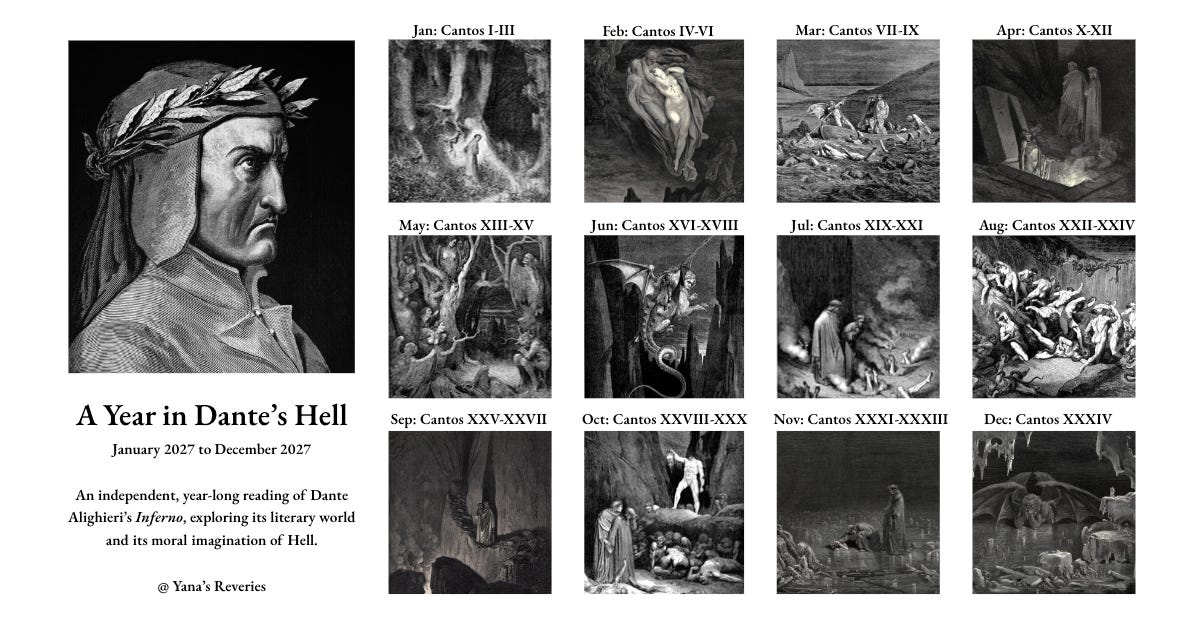
To put together this schedule, which divides the 34 cantos into 12 monthly blocks, I have drawn on other readers' personal curricula and study plans for Inferno, with help from AI. The themes are my starting thoughts about what each block might offer, and I expect some of them to change as I read, or to lead me towards questions that carry beyond their assigned month.
January (Cantos I–III)
Lostness, guidance, thresholds, and the beginning of judgment.
Primary reading: Hollander’s Inferno, Cantos I–III, including the notes.
The Cambridge Companion to Dante: “Life of Dante” and Lino Pertile’s “Introduction to Inferno.”
Virgil, Aeneid: Book VI, lines 264–416, covering the entrance to the underworld, its unburied dead, and Charon.
Danteworlds: Read the overview of Hell and the material accompanying the dark wood and the entrance to Hell.
Princeton Dante Project: Read Hollander’s commentary on Inferno I.1–3, I.31–60, II.52–126, and III.1–9, focusing on the opening, the beasts, the intervention of the three women, and the gate’s inscription.
February (Cantos IV–VI)
Virtue, desire, sympathy, and judgment.
Primary reading: Hollander’s Inferno, Cantos IV–VI, including the notes.
The Cambridge Companion to Dante: “Dante and the classical poets,” concentrating on the classical inheritance relevant to Limbo.
Augustine, Confessions: Book VIII, chapters 5–12, on habit, the divided will, and conversion.
Dartmouth Dante Project: Compare Hollander’s and Singleton’s commentary on Inferno V.100–138, particularly Francesca’s account of love and the lovers’ reading.
Danteworlds: Read the entries accompanying Limbo, lust, and gluttony, paying particular attention to the virtuous pagans, Francesca and Paolo, and Ciacco.
March (Cantos VII–IX)
Appetite, anger, power, and the limits of reason.
Primary reading: Hollander’s Inferno, Cantos VII–IX, including the notes.
Aquinas, Summa Theologiae: II–II, Question 158, articles 1–3, on anger, its relationship to reason, and its moral seriousness.
Danteworlds: Read the material accompanying avarice and prodigality, wrath and sullenness, and the approach to the City of Dis.
Princeton Dante Project: Read Hollander’s commentary on VII.67–96, concerning Fortune; VIII.31–63, concerning Filippo Argenti; and IX.64–105, concerning the heavenly messenger.
Comparison exercise: In Dartmouth, compare Hollander and Singleton on VIII.37–63, where the pilgrim’s anger and Virgil’s approval become especially difficult to interpret.
April (Cantos X–XII)
Knowledge, political memory, heresy, and violence.
Primary reading: Hollander’s Inferno, Cantos X–XII, including the notes.
The Cambridge Companion to Dante: “Dante and Florence.”
Princeton Dante Project: Read Hollander’s commentary on X.22–120, covering Farinata, Cavalcante, political conflict, and the knowledge of the damned.
Close rereading: Read XI.16–111 slowly, alongside the commentary, as Dante’s explanation of the organisation of lower Hell.
Danteworlds: Read the material on heresy and violence against others, particularly Farinata, the Minotaur, the centaurs, and the river of blood.
May (Cantos XIII–XV)
The body, self-destruction, reputation, and love.
Primary reading: Hollander’s Inferno, Cantos XIII–XV, including the notes.
Augustine, Confessions: Book X, chapters 8–17, on memory and the difficulty of understanding oneself.
Aquinas, Summa Theologiae: II–II, Question 64, article 5, on suicide, read as theological context for Dante’s treatment rather than as a contemporary account of suicidal suffering.
Dartmouth Dante Project: Compare Hollander and Singleton on XIII.31–108, concerning Pier della Vigna, and XV.22–99, concerning Brunetto Latini.
Princeton Dante Project: Read the notes on XIV.94–120, the Old Man of Crete, to understand the image and its scriptural background.
June (Cantos XVI–XVIII)
Human creation, fraud, appearances, and the midpoint of the journey.
Primary reading: Hollander’s Inferno, Cantos XVI–XVIII, including the notes.
Barolini, The Undivine Comedy: Chapter 3, “Ulysses, Geryon, and the Aeronautics of Narrative Transition.” This will also be worth returning to in September.
Princeton Dante Project: Read Hollander’s commentary on XVI.124–136 and XVII.1–27, covering the announcement of Geryon and his appearance.
Danteworlds: Read the material on Geryon, usury, and the first two bolgias of fraud.
Close rereading: Read XVII.79–136, the flight on Geryon, alongside Barolini’s discussion of narrative transition.
July (Cantos XIX–XXI)
Sacred authority, corruption, performance, and institutional sin.
Primary reading: Hollander’s Inferno, Cantos XIX–XXI, including the notes.
The Cambridge Companion to Dante: “The theology of the Comedy.”
Bible: Acts 8:9–24, the story of Simon Magus; Matthew 23:1–36, on religious hypocrisy; and John 11:45–53, for the Caiaphas reference in Canto XXI.
Princeton Dante Project: Read Hollander’s commentary on XIX.1–6 and XIX.31–117, covering simony and the encounter with Nicholas III.
Dartmouth Dante Project: Compare Hollander and Singleton on XX.19–30, where Virgil rebukes the pilgrim’s pity, and XXI.37–54, concerning political corruption.
August (Cantos XXII–XXIV)
Hypocrisy, theft, transformation, and the unstable self.
Primary reading: Hollander’s Inferno, Cantos XXII–XXIV, including the notes.
Aquinas, Summa Theologiae: II–II, Question 111, articles 1–4, on dissimulation and hypocrisy.
Danteworlds: Read the material accompanying the barrators, hypocrites, and thieves.
Princeton Dante Project: Read Hollander’s commentary on XXIII.58–126, covering the leaden cloaks, the Jovial Friars, and Caiaphas.
Dartmouth Dante Project: Compare Hollander and Singleton on XXIV.97–120, Vanni Fucci’s destruction and reconstitution. Leave the more elaborate transformations in Canto XXV for September.
September (Cantos XXV–XXVII)
Intelligence, curiosity, eloquence, and moral responsibility.
Primary reading: Hollander’s Inferno, Cantos XXV–XXVII, including the notes.
The Cambridge Companion to Dante: Return to “Dante and the classical poets.”
Homer, Odyssey: Book XI, the encounter with the dead, and Book XII, the dangerous return voyage.
Barolini, The Undivine Comedy: Return to Chapter 3, “Ulysses, Geryon, and the Aeronautics of Narrative Transition.”
Dartmouth Dante Project: Compare Hollander and Singleton on XXVI.85–142, Ulysses’ final voyage, and XXVII.61–129, Guido da Montefeltro’s account of counsel, repentance, and absolution.
October (Cantos XXVIII–XXX)
Division, falsification, embodiment, and the fragility of truth.
Primary reading: Hollander’s Inferno, Cantos XXVIII–XXX, including the notes.
Aquinas, Summa Theologiae: II–II, Question 110, articles 1–4, on lying and its moral classification.
Danteworlds: Read the material on sowers of discord and falsifiers, including Bertran de Born, the alchemists, impersonators, counterfeiters, and liars.
Princeton Dante Project: Read Hollander’s commentary on XXVIII.118–142, Bertran de Born and the explicit naming of contrapasso.
Dartmouth Dante Project: Compare Hollander and Singleton on XXX.49–129, the encounter with Master Adam and Sinon, then read XXX.130–148 on the pilgrim’s fascination with their quarrel.
November (Cantos XXXI–XXXIII)
Power, betrayal, grief, and the destruction of relationship.
Primary reading: Hollander’s Inferno, Cantos XXXI–XXXIII, including the notes.
The Cambridge Companion to Dante: Return to “Dante and Florence” for the political background to these encounters.
Bible: Genesis 11:1–9, the Tower of Babel, alongside Nimrod’s appearance in Canto XXXI.
Dartmouth Dante Project: Compare Hollander and Singleton on XXXII.73–111, concerning Bocca degli Abati, and XXXIII.1–90, concerning Ugolino.
Princeton Dante Project: Read Hollander’s commentary on XXXIII.109–157, the encounter with Fra Alberigo and the claim that a soul can enter Hell while its body remains alive.
December (Canto XXXIV and the whole poem)
Evil, freedom, transformation, and leaving Hell.
Primary reading: Hollander’s Inferno, Canto XXXIV, including the notes.
Rereading: I.1–90; V.100–142; XIII.31–108; XXVI.85–142; and XXXIII.1–90, returning to the dark wood, Francesca, Pier della Vigna, Ulysses, and Ugolino.
Augustine, Confessions: Book VII, chapters 12–16, on goodness, corruption, evil, and the will.
Freccero, Dante: The Poetics of Conversion: “The Prologue Scene,” returning to the beginning after reaching the end.
Princeton Dante Project: Read Hollander’s commentary on XXXIV.28–67, Lucifer’s appearance, and XXXIV.70–139, the reversal of direction and the departure from Hell.
I would love to have fellow readers alongside me, whether to talk through a passage, offer another interpretation, point me towards a useful resource, or help me see something I have missed, and you're welcome to join a conversation even without following the reading plan yourself.
Yours in thought,
Yana