
I do not want to die before building a mind worth listening to.
The Reading Project: I’m reading and writing about demanding works across literature, philosophy, psychology, intellectual history, and the sciences of mind.
Suggestions: If you have a book recommendation for this project, comment, message or email me at saiyanaramisetty@substack.com
The Reading List
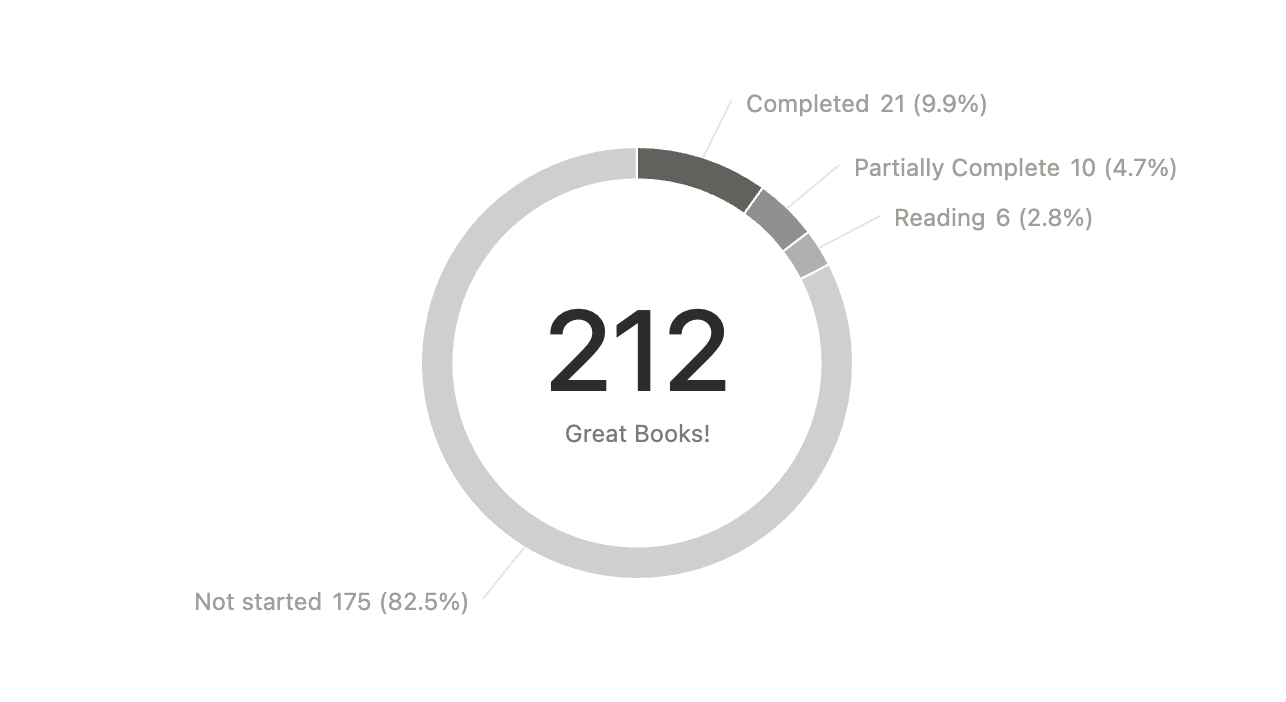
Note: Many texts read prior to when I began writing publicly are not included in this list. The works selected here are those that fall within the genres defined for this project.
How it’s organized (quick navigation)
Tier 1 — Foundations (39): The roots of the way we think.
Tier 2 — Mind & Morality (39): The inner life, and the problem of being good.
Tier 3 — Society & Culture (39): How we build worlds, and get shaped by them.
Tier 4 — Consciousness (36): What it is like to be a mind.
Tier 5 — Spirituality & Literature (54): Reading for awe, ache, and attention.
Reading statues: ▶ Reading | 🔜 Next Pick | ◐ Partially Complete | ✔️ Completed
The Greek Dispatches

The Greek Dispatches is me slowly reading Greek literature, tragedies, and mythology as a long, lived thing by staying inside the events until they start giving me meaning.
Tier 1 = Foundations
The oldest, most formative texts. Stuff that built the basic vocabulary of tragedy, virtue, reason, politics, and the novel.
The Iliad — Homer (c. 750 BCE) ▶
The Odyssey — Homer (c. 725 BCE) 🔜
Oresteia — Aeschylus (458 BCE)
Antigone — Sophocles (441 BCE) ✔️
Oedipus Rex — Sophocles (429 BCE) ✔️
The Frogs — Aristophanes (405 BCE)
Apology — Plato (399 BCE)
Symposium — Plato (385 BCE)
The Republic — Plato (c. 375 BCE)
Phaedo — Plato (c. 360 BCE)
De Anima — Aristotle (c. 350 BCE)
Poetics — Aristotle (c. 350 BCE)
Nicomachean Ethics — Aristotle (c. 340 BCE)
The Aeneid — Virgil (19 BCE)
Discourses — Epictetus (c. 125 CE)
Meditations — Marcus Aurelius (c. 180 CE)
Beowulf — Anonymous (c. 1000) ✔️
Sir Gawain and the Green Knight — Anonymous (c. 1400) ✔️
The Canterbury Tales — Geoffrey Chaucer (c. 1400) ◐
The Second Shepherd’s Play — The Wakefield Master (c. 1500)
Utopia — Thomas More (1516)
A Midsummer Night’s Dream — William Shakespeare (1595)
Twelfth Night — William Shakespeare (1602)
Hamlet — William Shakespeare (1603)
Othello — William Shakespeare (1603)
Don Quixote — Miguel de Cervantes (1605)
King Lear — William Shakespeare (1606)
Macbeth — William Shakespeare (1606) ◐
Meditations on First Philosophy — René Descartes (1641)
Paradise Lost — John Milton (1667) ◐
An Essay Concerning Human Understanding — John Locke (1689)
A Treatise of Human Nature — David Hume (1739)
Joseph Andrews — Henry Fielding (1742)
An Enquiry Concerning Human Understanding — David Hume (1748)
Groundwork of the Metaphysics of Morals — Immanuel Kant (1785)
Pride and Prejudice — Jane Austen (1813) ✔️
Leaves of Grass — Walt Whitman (1855)
Great Expectations — Charles Dickens (1861)
1984 — George Orwell (1949)
Tier 2 = Mind & Morality
Books that stay close to the inner life. Desire, guilt, meaning, confusion, breakdown, repair. Also a few works that try to describe the mind more directly.
Doctor Faustus — Christopher Marlowe (1604)
The Duchess of Malfi — John Webster (1623)
Emma — Jane Austen (1815)
Jane Eyre — Charlotte Brontë (1847)
Wuthering Heights — Emily Brontë (1847)
David Copperfield — Charles Dickens (1850)
The Scarlet Letter — Nathaniel Hawthorne (1850)
Notes from Underground — Fyodor Dostoevsky (1864) ◐
Anna Karenina — Leo Tolstoy (1878)
Adventures of Huckleberry Finn — Mark Twain (1884)
The Death of Ivan Ilyich — Leo Tolstoy (1886)
Heart of Darkness — Joseph Conrad (1899)
The Interpretation of Dreams — Sigmund Freud (1899)
Beyond the Pleasure Principle — Sigmund Freud (1920)
Psychological Types — Carl Jung (1921)
Siddhartha — Hermann Hesse (1922)
Steppenwolf — Hermann Hesse (1927)
Civilization and Its Discontents — Sigmund Freud (1930)
Modern Man in Search of a Soul — Carl Jung (1933)
The Myth of Sisyphus — Albert Camus (1942) ◐
The Stranger — Albert Camus (1942) ✔️
Man’s Search for Meaning — Viktor Frankl (1946)
The Plague — Albert Camus (1947)
The Fall — Albert Camus (1956)
Exile and the Kingdom — Albert Camus (1957)
The Divided Self — R. D. Laing (1960)
On Becoming a Person — Carl Rogers (1961)
The Bell Jar — Sylvia Plath (1963)
Man and His Symbols — Carl Jung (1964)
Identity: Youth and Crisis — Erik Erikson (1968)
The Will to Meaning — Viktor Frankl (1969)
Playing and Reality — Donald Winnicott (1971)
The Denial of Death — Ernest Becker (1973)
Consciousness Explained — Daniel C. Dennett (1991)
Descartes’ Error — Antonio Damasio (1994)
The Emotional Brain — Joseph LeDoux (1996)
Being No One — Thomas Metzinger (2003)
Self Comes to Mind — Antonio Damasio (2010)
The Four Realms of Existence — Joseph LeDoux (2023)
Tier 3 = Society & Culture
Books that zoom out from the individual. How people build worlds together. Power, institutions, history, freedom, cruelty, and the stories societies tell about themselves.
History of the Peloponnesian War — Thucydides (c. 400 BCE)
Gulliver’s Travels — Jonathan Swift (1726) ✔️
She Stoops to Conquer — Oliver Goldsmith (1773)
The Decline and Fall of the Roman Empire — Edward Gibbon (1776)
Phenomenology of Spirit — G. W. F. Hegel (1807)
Frankenstein — Mary Shelley (1818) ◐
Lectures on the Philosophy of History — G. W. F. Hegel (1837)
Madame Bovary — Gustave Flaubert (1856)
Tess of the d’Urbervilles — Thomas Hardy (1891)
The Protestant Ethic and the Spirit of Capitalism — Max Weber (1905)
Easter 1916 — W. B. Yeats (1921)
The Story of Philosophy — Will Durant (1926)
A Room of One’s Own — Virginia Woolf (1929)
Brave New World — Aldous Huxley (1932) ◐
The Abolition of Man — C. S. Lewis (1943)
The Open Society and Its Enemies — Karl Popper (1945)
Why I Write — George Orwell (1946) ✔️
The Concept of Mind — Gilbert Ryle (1949)
The Hedgehog and the Fox — Isaiah Berlin (1953)
The Human Condition — Hannah Arendt (1958)
To Kill a Mockingbird — Harper Lee (1960) ✔️
Eichmann in Jerusalem — Hannah Arendt (1963)
The Discarded Image — C. S. Lewis (1964)
The Order of Things — Michel Foucault (1966)
Four Essays on Liberty — Isaiah Berlin (1969)
The Sovereignty of Good — Iris Murdoch (1970)
Discipline and Punish — Michel Foucault (1975)
Poetry Is Not a Luxury — Audre Lorde (1977) ✔️
The Life of the Mind — Hannah Arendt (1978)
After Virtue — Alasdair MacIntyre (1981)
Reasons and Persons — Derek Parfit (1984)
Sources of the Self — Charles Taylor (1989)
The End of Certainty — Ilya Prigogine (1990)
The Ethics of Authenticity — Charles Taylor (1992)
Dependent Rational Animals — Alasdair MacIntyre (1999)
The Making of the Modern Mind — Peter Watson (2002)
A Secular Age — Charles Taylor (2007)
The Origins of Political Order — Francis Fukuyama (2011)
The Human Predicament — David Benatar (2016)
Tier 4 = Consciousness
Books that keep circling one question: what is it like to be a mind? Attention, perception, selfhood, language, time, and the strange fact of being aware.
Tristram Shandy — Laurence Sterne (1759)
The World as Will and Representation — Arthur Schopenhauer (1818)
The Idiot — Fyodor Dostoevsky (1869)
Middlemarch — George Eliot (1871)
Demons — Fyodor Dostoevsky (1872)
The Brothers Karamazov — Fyodor Dostoevsky (1880)
The Portrait of a Lady — Henry James (1881)
The Gay Science — Friedrich Nietzsche (1882)
Thus Spoke Zarathustra — Friedrich Nietzsche (1883)
Beyond Good and Evil — Friedrich Nietzsche (1886) ◐
On the Genealogy of Morals — Friedrich Nietzsche (1887)
Dubliners — James Joyce (1914)
Kokoro — Natsume Sōseki (1914)
The Love Song of J. Alfred Prufrock — T. S. Eliot (1915)
A Portrait of the Artist as a Young Man — James Joyce (1916)
Mrs Dalloway — Virginia Woolf (1925)
The Trial — Franz Kafka (1925)
The Castle — Franz Kafka (1926)
Being and Time — Martin Heidegger (1927)
To the Lighthouse — Virginia Woolf (1927)
The Sound and the Fury — William Faulkner (1929)
Being and Nothingness — Jean-Paul Sartre (1943)
The Ethics of Ambiguity — Simone de Beauvoir (1947)
Philosophical Investigations — Ludwig Wittgenstein (1953)
Empiricism and the Philosophy of Mind — Wilfrid Sellars (1956)
The Dragons of Eden — Carl Sagan (1977) ✔️
Mortal Questions — Thomas Nagel (1979)
The Mind’s I — Douglas Hofstadter & Daniel C. Dennett (1981)
The Book of Disquiet — Fernando Pessoa (1982)
Blood Meridian — Cormac McCarthy (1985)
The View from Nowhere — Thomas Nagel (1986)
Mind and World — John McDowell (1994)
Maps of Meaning — Jordan Peterson (1999)
Kafka on the Shore — Haruki Murakami (2002)
The Road — Cormac McCarthy (2006)
The Truth of Fact, The Truth of Feeling — Ted Chiang (2013) ✔️
Tier 5 = Spirituality & Literature
Books I go to when I want to be changed more than informed. Scripture, contemplative philosophy, and literature that feels like prayer, ache, or attention.
Upanishads — Anonymous (c. 500 BCE)
The Bacchae — Euripides (405 BCE)
Dhammapada — Anonymous (c. 300 BCE)
Tao Te Ching — Laozi (c. 300 BCE)
The Complete Writings — Zhuangzi (c. 300 BCE)
Bhagavad Gita — Anonymous (c. 200 BCE) ◐
Library (Bibliotheca) — Apollodorus (c. 100 BCE) ▶
Mulamadhyamakakarika — Nagarjuna (c. 150 BCE)
Fabulae — Hyginus (c. 200 BCE) ▶
Iphigenia at Aulis — Euripides (c. 200) ▶
Helen — Euripides (c. 412) ▶
Commentary on the Brahma Sutra — Adi Shankara (c. 800)
Shōbōgenzō (Selections) — Dōgen (1231)
The Divine Comedy — Dante Alighieri (c. 1320) ◐
The Faerie Queene (Book I) — Edmund Spenser (1590)
Pensées — Blaise Pascal (1670)
Expostulation and Reply — William Wordsworth (1798) ✔️
Lines Written a Few Miles Above Tintern Abbey — William Wordsworth (1798)
Lucy Poems — William Wordsworth (1798) ✔️
The Rime of the Ancient Mariner — Samuel Taylor Coleridge (1798)
The Tables Turned — William Wordsworth (1798) ✔️
We Are Seven — William Wordsworth (1798) ✔️
Michael — William Wordsworth (1800) ✔️
Ode: Intimations of Immortality — William Wordsworth (1807)
Ode on a Grecian Urn — John Keats (1819)
Ode on Melancholy — John Keats (1819)
Ode to a Nightingale — John Keats (1819)
Ode to Autumn — John Keats (1819)
La Belle Dame sans Merci — John Keats (1820)
The Red and the Black — Stendhal (1830)
Bright Star — John Keats (1838)
White Nights — Fyodor Dostoevsky (1848) ✔️
Moby-Dick — Herman Melville (1851)
War and Peace — Leo Tolstoy (1869)
The Stolen Child — W. B. Yeats (1886)
The Lake Isle of Innisfree — W. B. Yeats (1890)
Resurrection — Leo Tolstoy (1899)
Ideas I — Edmund Husserl (1913)
I Have More Souls Than One — Fernando Pessoa (1918) ✔️
The Second Coming — W. B. Yeats (1919)
The Waste Land — T. S. Eliot (1922)
Leda and the Swan — W. B. Yeats (1924)
The Magic Mountain — Thomas Mann (1924)
Sailing to Byzantium — W. B. Yeats (1927)
Among School Children — W. B. Yeats (1928)
Letters to a Young Poet — Rainer Maria Rilke (1929) ✔️
Murder in the Cathedral — T. S. Eliot (1935)
The Circus Animals’ Desertion — W. B. Yeats (1939)
Four Quartets — T. S. Eliot (1943)
What Is Life? — Erwin Schrödinger (1944)
Waiting for Godot — Samuel Beckett (1952)
The Structure of Scientific Revolutions — Thomas Kuhn (1962)
One Hundred Years of Solitude — Gabriel García Márquez (1967)
The Selfish Gene — Richard Dawkins (1976)
The Unbearable Lightness of Being — Milan Kundera (1984)
Beloved — Toni Morrison (1987)
Homeric Hymns — trans. Michael Crudden (2001) ▶
The White Book — Han Kang (2016) ✔️
The Order of Time — Carlo Rovelli (2017)