

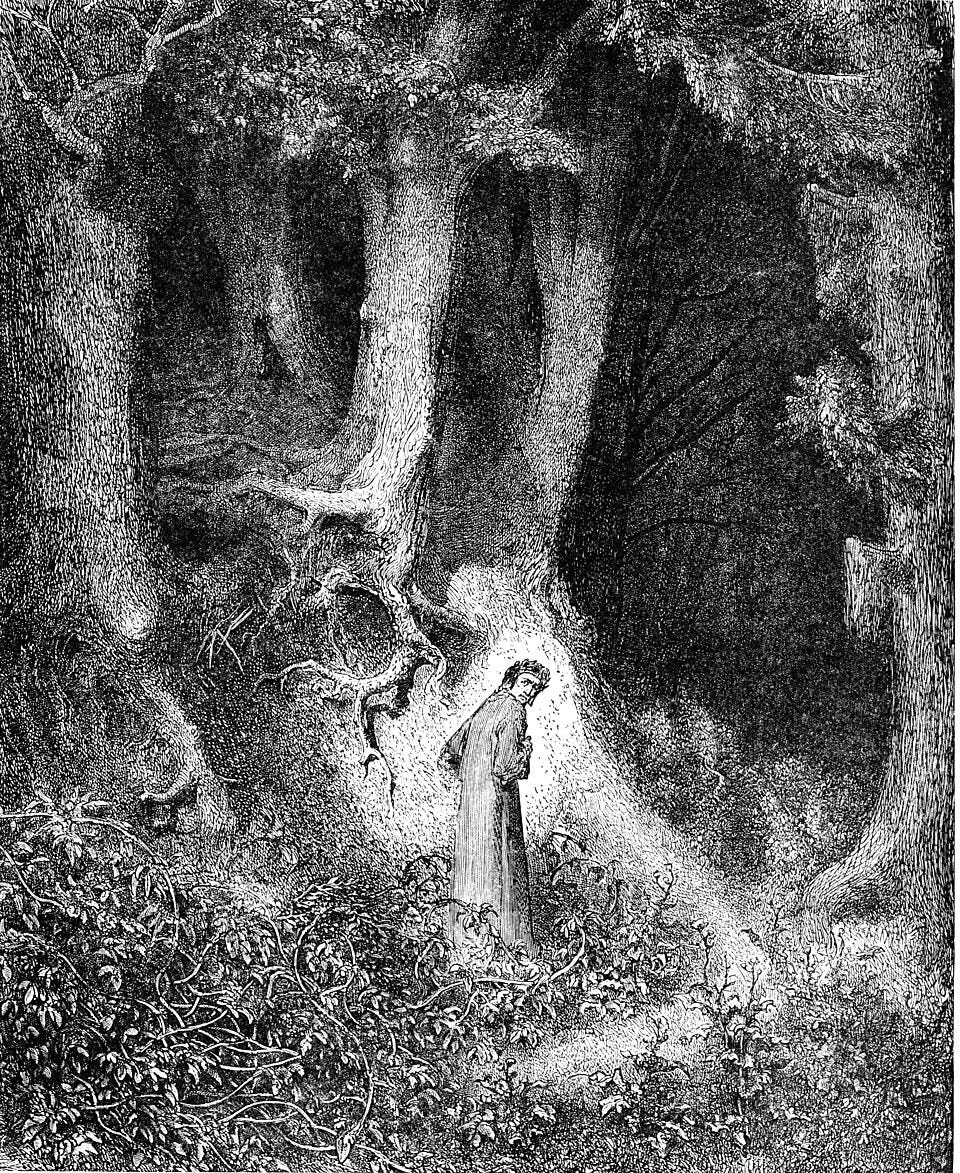
The question I cannot let go of after reading Canto I of Inferno is why after seeing the illuminated hill, he turns back towards it?
I just began my Hell’s journey, and Virgil has just appeared in the dark woods and identified himself. Dante is standing before the poet he has studied and loved, the poet from whom he believes he learned his own “noble style”. Imagining myself in the shoes of Dante, the first reaction I would feel is a moment of relief. Someone whom I can recognize has arrived and he seems to understand where he is. Yet Virgil’s first real question, is interesting, and has resonated in the back of my mind through the study session.
“But you, why are you turning back to misery? Why do you not climb the peak that gives delight, origin and cause of every joy?”
Why are you turning back?
This is making me think how Dante’s situation more difficult than I first understood it to be. He has seen the hill, and has begun to climb towards it. He could start to grasp that a way out exists, and he can see it. Still, when the beasts appear, especially the starving she-wolf, he wants to retreat towards the wood he was trying to escape.
The self I know inside misery
I initially thought this was simply fear, because, of course, venturing into the unknown is harder than remaining with the known, even when we know that the known has become miserable. That’s the one daunting “reality” we already know and understand. There were many times in my life, where misery has become the known ground, and I understood its paths and what I could expect from it. More importantly, I think, it is because I know what kind of person I am inside it. At those times, there is always a prospect of joy, which I yearn to desire, but it may also require me to become someone I do not yet know how to be. And that’s when I stop dead in my tracks and stick to the known misery.
Before I enter Hell

A pagan poet guiding a Christian pilgrim toward a God he cannot see.
Oh Dante, that is tragic to me.
In my previous piece on the Inferno’s introduction, I had already been wondering and thinking that pain is easier to understand than happiness. Extending that thought now, I think the difficulty is not just that happiness is harder to imagine. But the more pressing underlying problem is, happiness can feel less familiar than pain. Maybe in those times, the unknown good asks something of us that the known misery does it. What do you think about this? Is there any other way you can help me define this?
The hunger that never eats enough
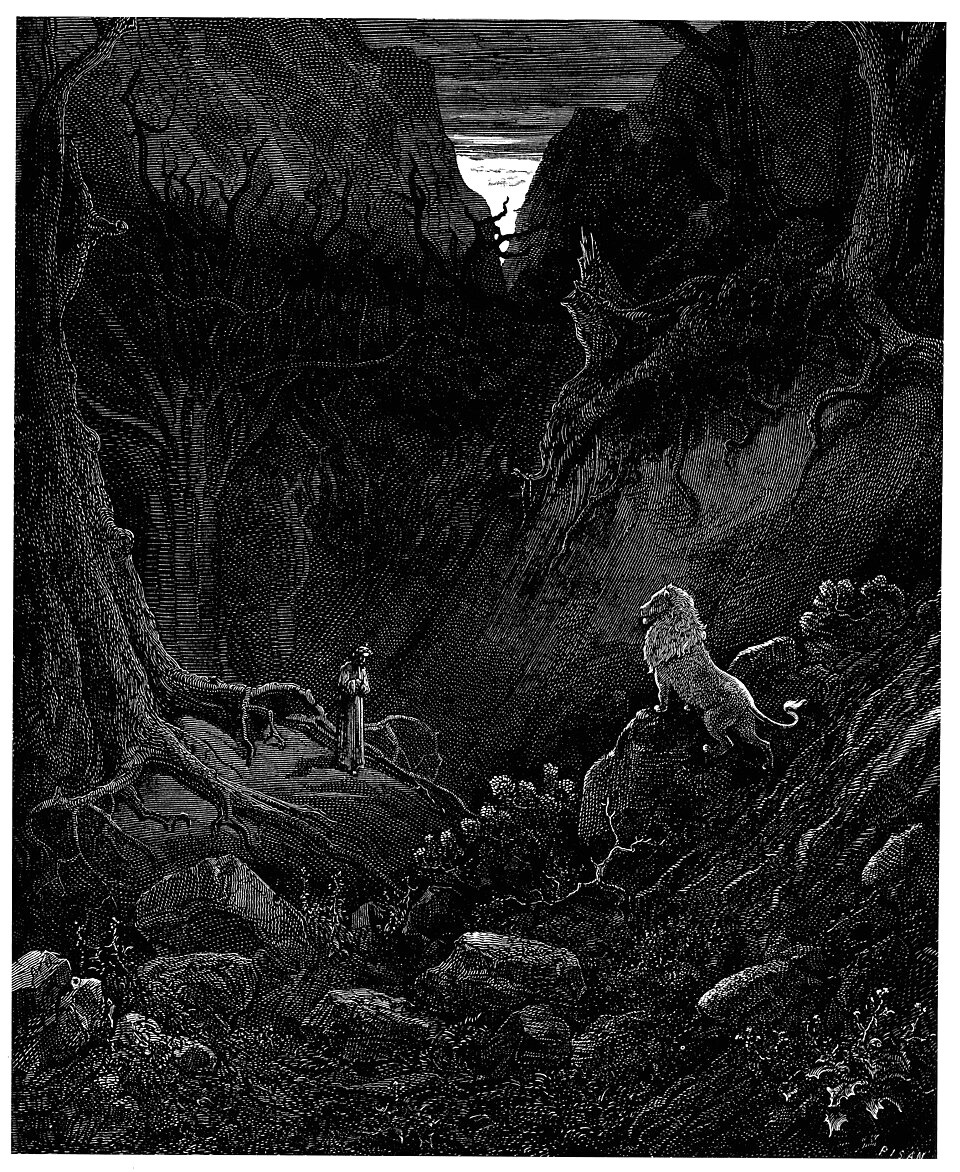
Alright, going back to the Canto. The hill appears before the beasts do, and Dante emerges from the darkness, looks up, sees its light, and in that moment, I may presume that his fear begins to quiet down. The woods are behind him, and the light is above him, and he only has to climb.
Now, the animals appear.
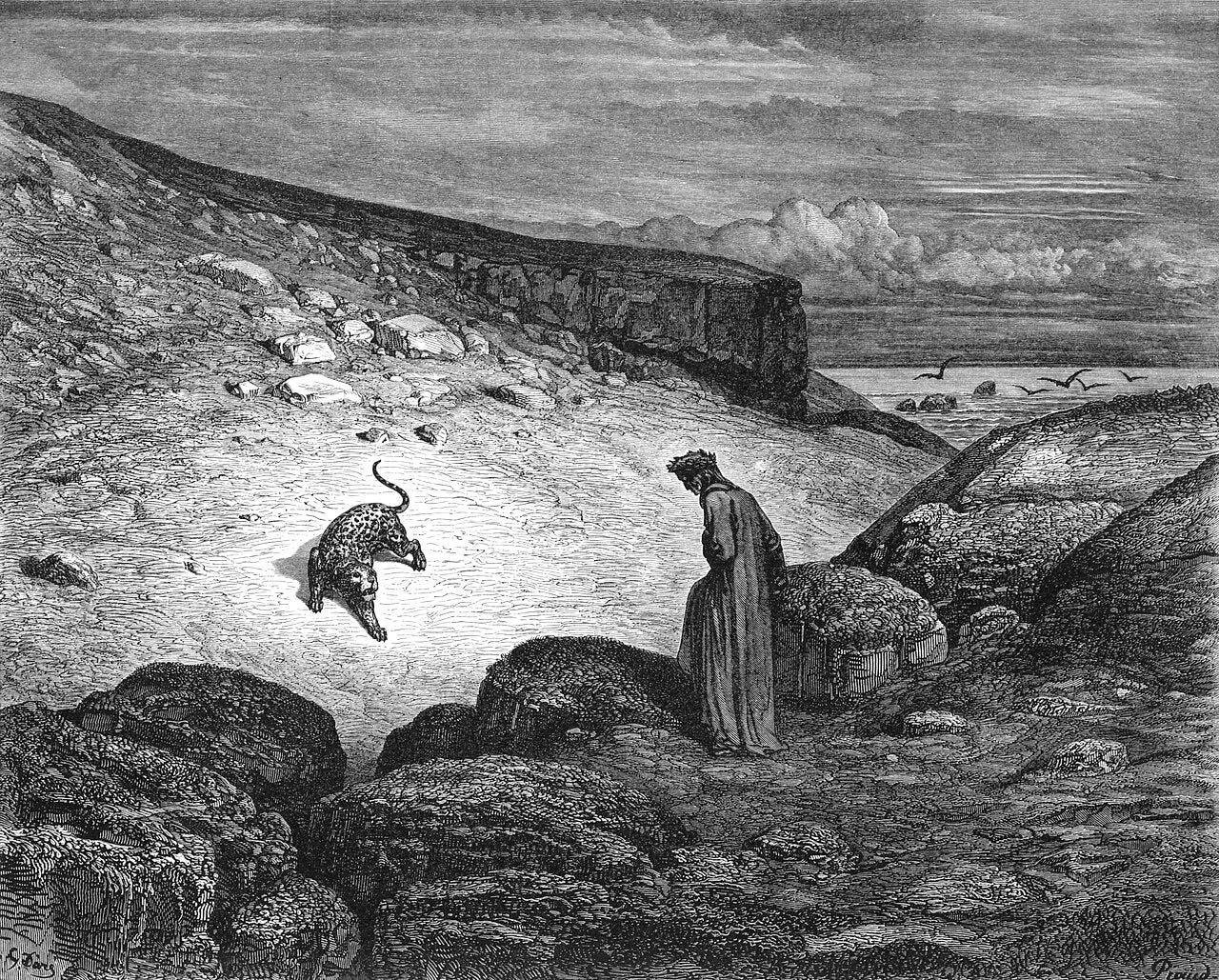
The she-wolf was interesting, she is thin, yet charged with all the appetites. Her hunger has already made many people miserable, and Virgil later says that feeding only makes her hungrier. The more she possesses, the more she wants.
My first note beside the passage was she simply resembled “greed”. The more I reread her passages, I could place almost anything insider her hunger — money, work, achievement, praise, certainty, knowledge, attention, love, anything. Even reading can become a form of appetite when I begin treating every book as something to finish, possess, or use before moving restlessly toward the next one.
That kept me thinking, why? Do I crave more because the last experience or acquisition has not settled whatever I hoped it would settle? Strangely, if we do feel that way, then that attempt was a failure, but it does not make us abandon the pursuit for the next and persuades us that we did not acquire enough. In the poem, its mentioned that she is thin despite everything she consumes. Does her thinness resemble the endless consumption that could lead to deprivation and the capacity to be never satisfied?
Not just Dante, she would have frightened me more as well.
Shame
When Virgil asks why he is returning to misery rather than climbing toward joy, Dante does not answer but instead he recognizes Virgil and says: “Are you then Virgil, the fountainhead that pours so full a stream of speech?” I answered him, my head bent low in shame.
Why does Dante lower his head? I still do not understand.
Dante praises Virgil as the honor and light of poets, even speaks of his long study and great love. Then calls him his master and author, the source from whom he took the beautiful style that brought him honor. But why is Dante ashamed?
I cannot think why. Is it just simple modesty before a revered poet? Dante has unexpectedly encountered the author whose work shaped his own. I can imagine the embarrassment of meeting someone I have read so closely that they have become part of my private mind. It is as if admiration can make me suddenly conscious of myself, of everything I know, and everything I do not know, and particularly of the distance between the work I admire and the person standing before it. Virgil has just asked Dante why he is retreating or fleeing, and Dante stands before his literary master at the moment of his own failure.
I have recently been stuck in a rut for some time and had continued to be, so I think I am asking myself why am I choosing the familiar misery again and again? Often I think we can give explanations. I was tired / the moment was wrong / the risk was too great / I needed more certainty / I was waiting until I felt ready. Some of these explanations may even be true. But at the same time, they can simply mean, I became afraid and retreated as well.
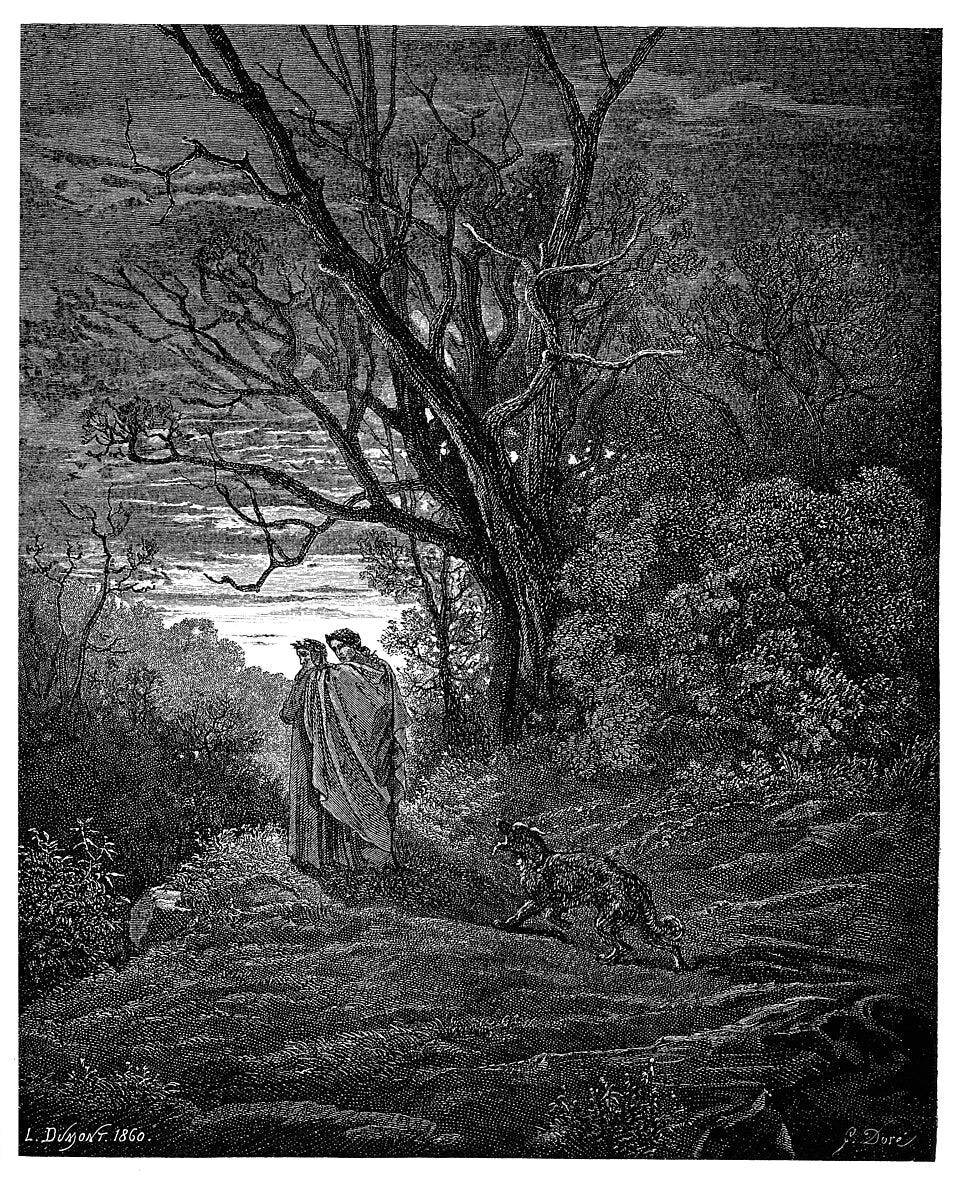
Virgil here clearly did not accuse Dante of cowardice, but he simply asked a question, to which Dante himself have answered with shame. This is why the bowed head interested me. Most often, shame begins when I see myself from outside, particularly through the eyes of someone whose judgement matters to me. Before Virgil had appeared, Dante’s fear was filled with the landscape and beasts, and I think once Virgil asked why he is turning back, Dante becomes capable of seeing his own movement within the scene. He has began responding to the frightening happening to him.
I wonder whether shame, in its least destructive form, begins at precisely this point. Does it appear in the narrow gap between the person I believe myself to be and the action I suddenly see myself performing?
Following before I am ready
Dante has apparently found the direction he needs to travel, and instead Virgil now tells him that he must take another road, that the she-wolf allows no one to pass. Dante will have to journey through Hell, hear the cries of the damned, climb the mountain of Purgatory, and only then approach the blessedness.
That is something very highly relatable to our everyday lives. Walking away from misery into building a life finding happiness, does take an effort worth traveling through Hell and finding Heaven.
I often assume clarity should be enough and once I understand that something is harmful, I expect understanding to release me from it. Once I see a better path, I expect myself to take it. When I do not, I treat the failure as evidence that I lacked discipline or never truly wanted to change.
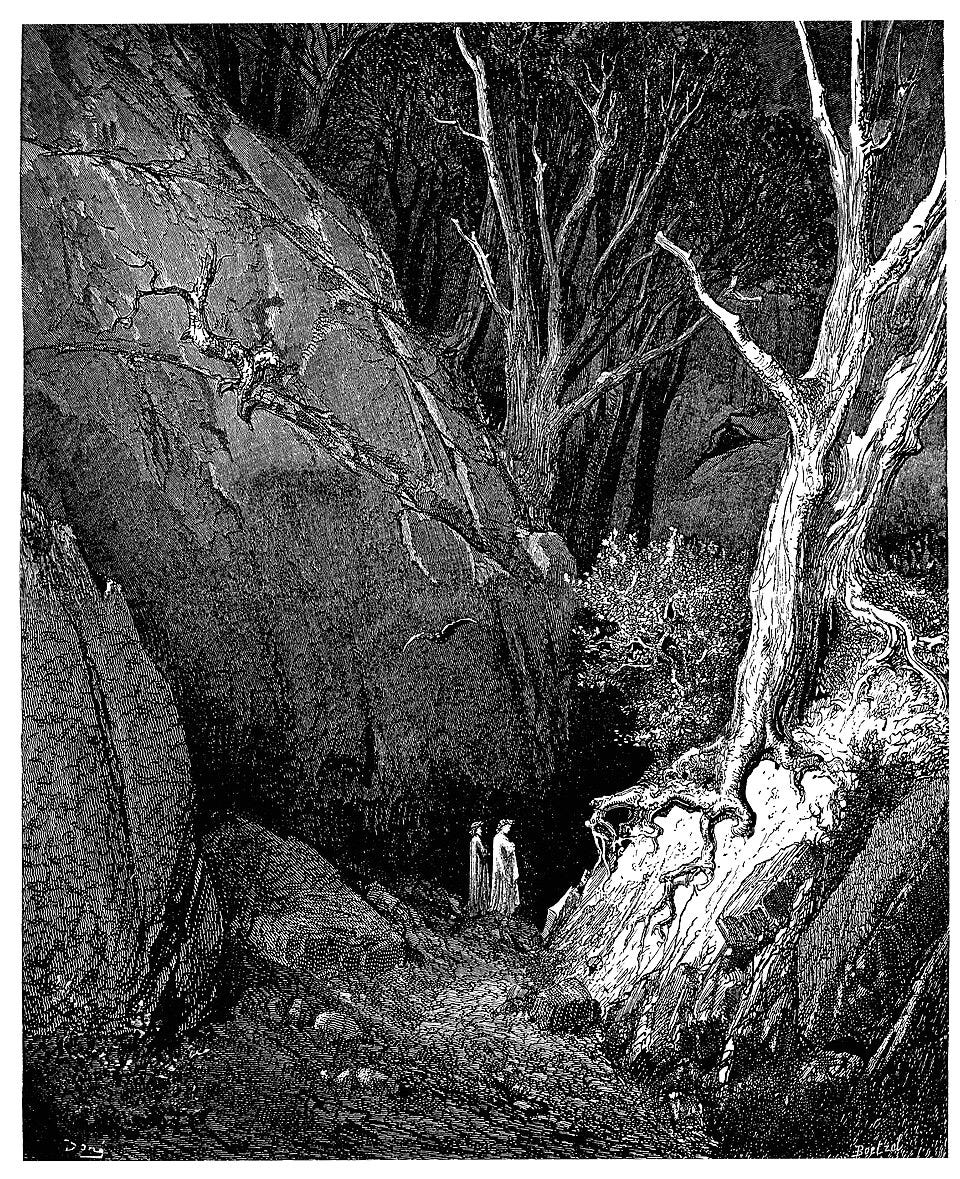
At the end of the canto, Virgil has moved and Dante had followed him.
How uncomfortable is it to follow someone without understanding where the journey might lead to? I do not think I have such courage to blindly do it, or acquire enough trust to take the next step. Do you?
I still do not know whether happiness is harder to understand than pain. Maybe I have been asking the question too abstractly. The poem will need three realms and a hundred cantos to discover what is concealed inside the retreat.
Virgil’s question of why turn back to misery, I still cannot answer it. The closest answer I can think of, is probably because I know who I am there. The more difficult question is whether I am willing to meet the person I might become elsewhere.
Yours in thought,
Yana